Reaction equation
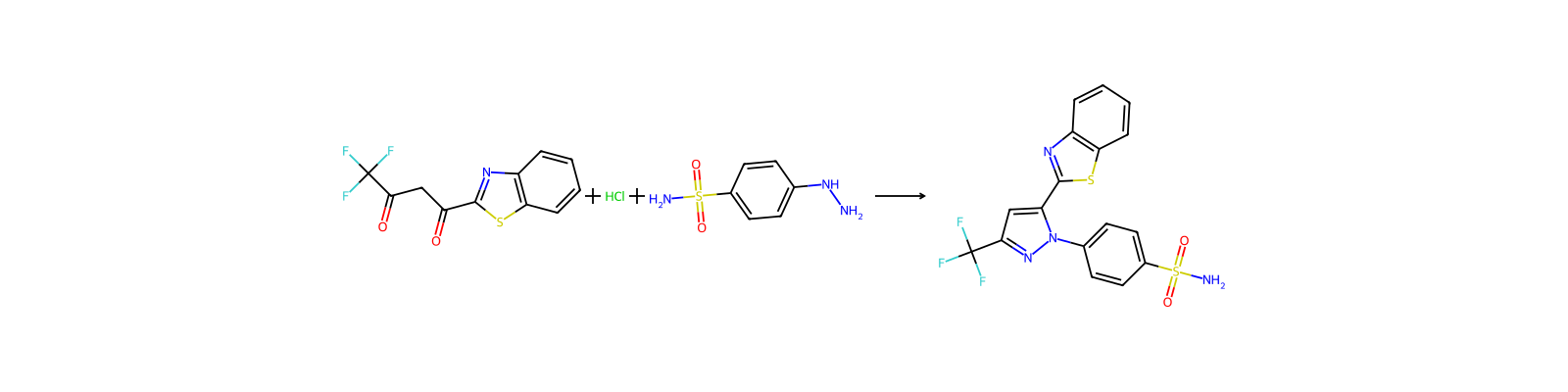
[S:1]1[C:5]2[CH:6]=[CH:7][CH:8]=[CH:9][C:4]=2[N:3]=[C:2]1[C:10](=O)[CH2:11][C:12](=O)[C:13]([F:16])([F:15])[F:14].Cl.[S:20]([C:24]1[CH:29]=[CH:28][C:27]([NH:30][NH2:31])=[CH:26][CH:25]=1)(=[O:23])(=[O:22])[NH2:21]>>[S:1]1[C:5]2[CH:6]=[CH:7][CH:8]=[CH:9][C:4]=2[N:3]=[C:2]1[C:10]1[N:30]([C:27]2[CH:26]=[CH:25][C:24]([S:20]([NH2:21])(=[O:23])=[O:22])=[CH:29][CH:28]=2)[N:31]=[C:12]([C:13]([F:16])([F:15])[F:14])[CH:11]=1Participants
3


Procedure
The product obtained in Example 7.1), 1-(benzothiazol-2-yl)-4,4,4-trifluorobutane-1,3-dione, was treated with 4-sulfamoylphenylhydrazine hydrochloride in the same manner as in Example 9 to give 4-[5-(benzothiazol-2-yl)-3-trifluoromethyl-1H-pyrazol-1-yl]benzenesulfonamide (yield, 44%).
Sources & evidence
- ORD record
- ord-bfb28d2ebc06473a9acb1ba69d74a1b3
- Source dataset
- uspto-grants-2000_10
- Patent number
- US06136831
Linked notes
Loading…