Pyridine → 2,2-Dimethyl-4-vinyl-1,3-dioxolane
Reaction equation
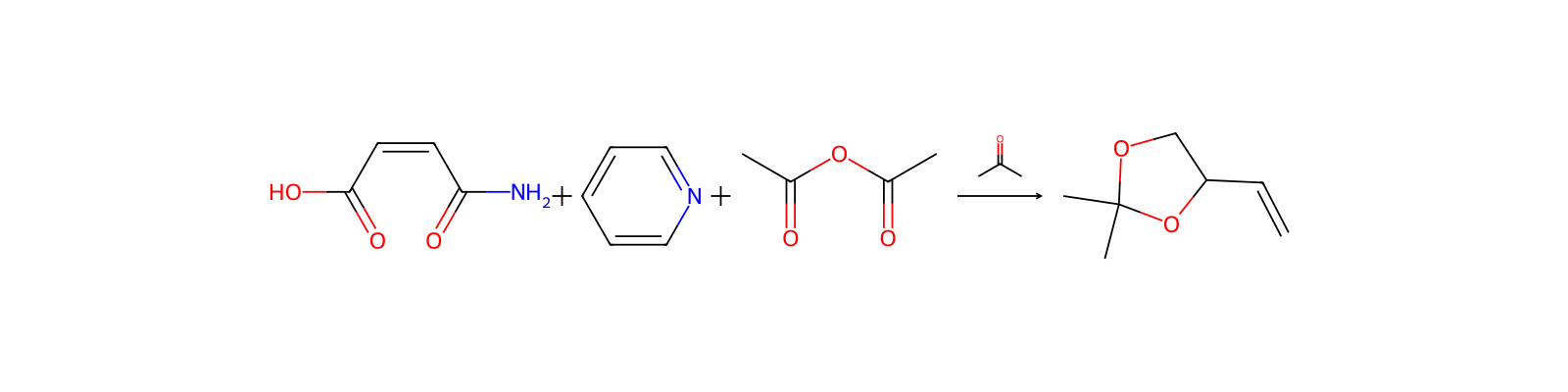
[C:1](O)(=O)/[CH:2]=[CH:3]\[C:4](N)=[O:5].N1C=C[CH:12]=[CH:11][CH:10]=1.C(OC(=O)C)(=[O:17])C>CC(C)=O>[CH3:10][C:11]1([CH3:12])[O:17][CH:3]([CH:4]=[CH2:5])[CH2:2][O:1]1Participants
Reactant 3



Product 1

Reagents, catalysts & solvents 1

Conditions
- Temperature
- 50 °C
Procedure
The maleamic acid copolymer of Example 8 was cyclized as follows. The procedure described in Example 8 was repeated, but prior to precipitation pyridine (2 grams, 25 mmol) was added, the solution stirred for 15 minutes, followed by the addition of 3 grams (29 mmol) of acetic anhydride. The solution was heated to 50° C. and stirred for 1 hour. The reaction mixture was then diluted with 5 grams acetone and precipitated into a heptane/ethyl ether (2:1) mixture. The solid product was collected using suction filtration and dried under vacuum at 40° C. for 20 hours. Yield was 0.54 grams of a maleimide/dioxolane copolymer 27% theory. Mn=2900, Mw=5420, Mw/Mn=1.87. The NMR spectrum indicates that the phenyl group has been incorporated in an approximately 1 to 1 ratio with the dioxolane group. The NMR spectrum is similar to the spectrum of a copolymer obtained by polymerizing a preformed n-phenyl maleimide monomer with a 2,2-dimethyl-4-vinyl-1,3-dioxolane monomer.
Workup
- additionwas added
- stirringstirred for 1 hour
- customprecipitated into a heptane/ethyl ether (2:1) mixture
- customThe solid product was collected
- filtrationsuction filtration
- customdried under vacuum at 40° C. for 20 hours
Sources & evidence
- ORD record
- ord-8f969c5f4a454642849cc87effd923eb
- Source dataset
- uspto-grants-1995_05
- Patent number
- US05418294
Reaction notes
Loading…