Pyridine → N-(2,4,6-trimethoxyphenyl)-N'-(4-isopropylcyclohexyl)urea
Reaction equation
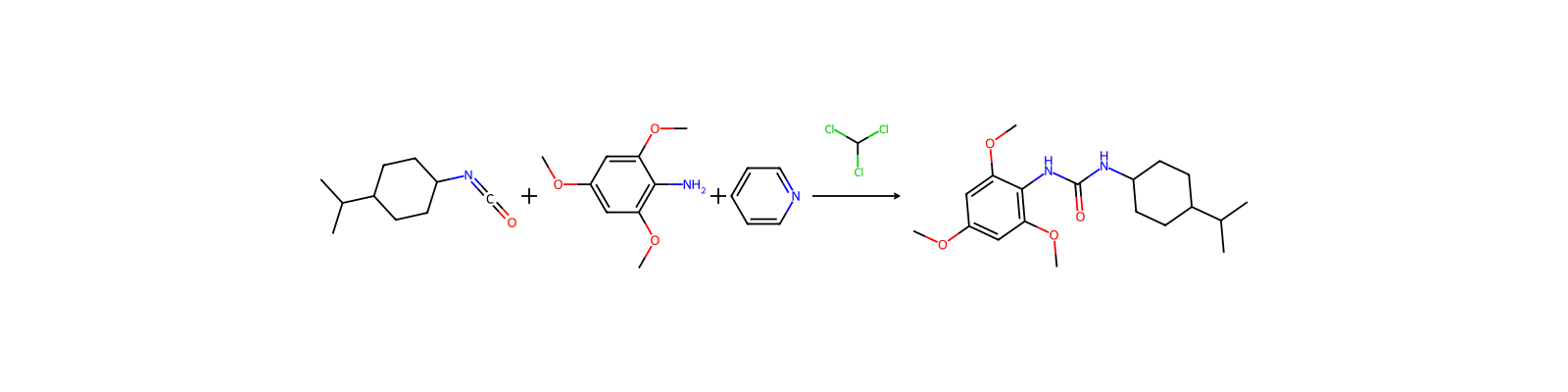
[CH:1]([CH:4]1[CH2:9][CH2:8][CH:7]([N:10]=[C:11]=[O:12])[CH2:6][CH2:5]1)([CH3:3])[CH3:2].[CH3:13][O:14][C:15]1[CH:21]=[C:20]([O:22][CH3:23])[CH:19]=[C:18]([O:24][CH3:25])[C:16]=1[NH2:17].N1C=CC=CC=1>C(Cl)(Cl)Cl>[CH3:25][O:24][C:18]1[CH:19]=[C:20]([O:22][CH3:23])[CH:21]=[C:15]([O:14][CH3:13])[C:16]=1[NH:17][C:11]([NH:10][CH:7]1[CH2:8][CH2:9][CH:4]([CH:1]([CH3:3])[CH3:2])[CH2:5][CH2:6]1)=[O:12]Participants
5
Reactant 3



Product 1

Reagents, catalysts & solvents 1

Procedure
To a solution of 1.6 g of 4-isopropylcyclohexylisocyanate in chloroform is added a solution of 1.8 g of 2,4,6-trimethoxyaniline in chloroform dropwise in the presence of pyridine. The mixture is stirred at room temperature until starting compounds disappear on TLC. The resultant mixture is concentrated and the residue is dissolved in ethyl acetate. The solution is washed with diluted hydrochloric acid, aqueous sodium hydrogencarbonate solution and brine. The organic layer is dried over magnesium sulfate and filtered off. The filtrate is distilled away and the resulting residue is crystallized to give N-(2,4,6-trimethoxyphenyl)-N'-(4-isopropylcyclohexyl)urea.
Workup
- concentrationThe resultant mixture is concentrated
- dissolutionthe residue is dissolved in ethyl acetate
- washThe solution is washed with diluted hydrochloric acid, aqueous sodium hydrogencarbonate solution and brine
- dry with materialThe organic layer is dried over magnesium sulfate
- filtrationfiltered off
- distillationThe filtrate is distilled away
- customthe resulting residue is crystallized
Sources & evidence
- ORD record
- ord-374741eaee854b63a8671fa751bb72c9
- Source dataset
- uspto-grants-1995_05
- Patent number
- US05420164
Reaction notes
Loading…