Reaction equation

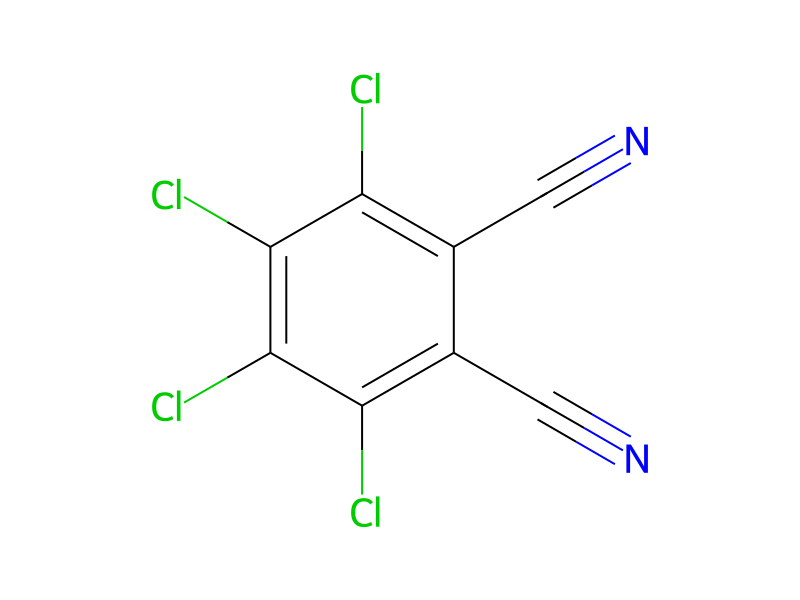
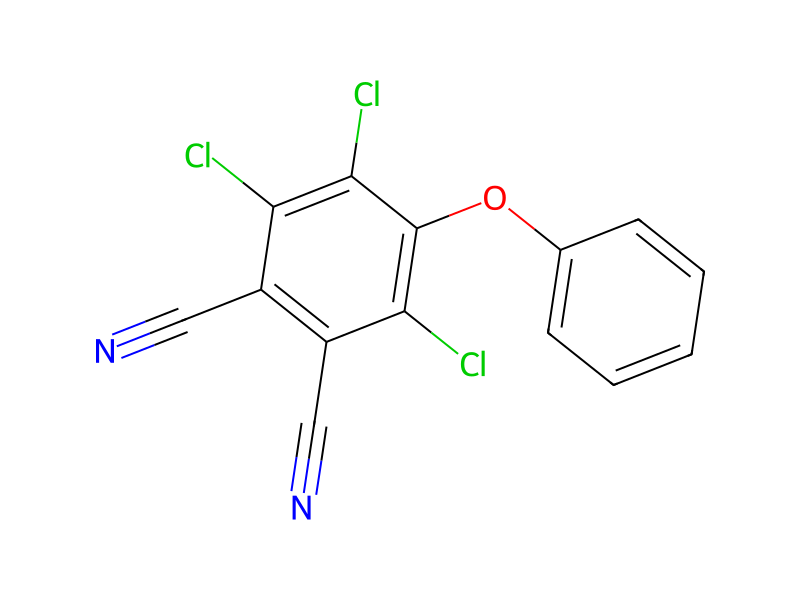
[OH-].[K+].[Cl:3][C:4]1[C:5]([C:15]#[N:16])=[C:6]([C:13]#[N:14])[C:7]([Cl:12])=[C:8](Cl)[C:9]=1[Cl:10].[C:17]1([OH:23])[CH:22]=[CH:21][CH:20]=[CH:19][CH:18]=1>O.CC(C)=O>[Cl:12][C:7]1[C:6]([C:13]#[N:14])=[C:5]([C:15]#[N:16])[C:4]([Cl:3])=[C:9]([Cl:10])[C:8]=1[O:23][C:17]1[CH:22]=[CH:21][CH:20]=[CH:19][CH:18]=1Participants
6




Conditions
- Temperature
- 60 °C
Procedure
A solution of potassium hydroxide (11.2 parts) in water (22 parts) was added dropwise to a stirred solution of 3,4,5,6-tetra-chloro-1,2-dicyanobenzene (26.6 parts) and phenol (9.4 parts) in acetone (100 parts) at 0° C. The solution was stirred at 60° C. for 2 hours before pouring into water (500 parts). The aqueous mixture was extracted with dichloromethane (3×500 parts). The dichloromethane extracts were washed with water (3×200 parts), dried over anhydrous Na2SO4, filtered and the dichloromethane was removed under reduced pressure to leave a brown solid. The solid was recrystallised from butan-1-ol. 3,5,6-Trichloro-l,2-dicyano-4-phenoxybenzene (17 parts) was obtained as a brown solid, m.p. 147°-150° C.
Workup
- extractionThe aqueous mixture was extracted with dichloromethane (3×500 parts)
- washThe dichloromethane extracts were washed with water (3×200 parts)
- dry with materialdried over anhydrous Na2SO4
- filtrationfiltered
- customthe dichloromethane was removed under reduced pressure
- customto leave a brown solid
- customThe solid was recrystallised from butan-1-ol
Sources & evidence
- ORD record
- ord-b1f09a514c604048b7f09759058b87b6
- Source dataset
- uspto-grants-1996_01
- Patent number
- US05486274
Linked notes
Loading…