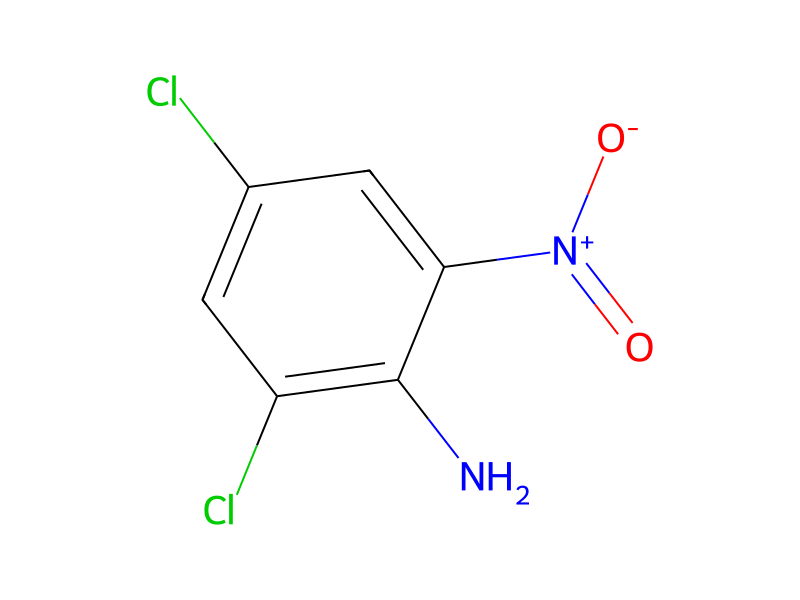
Ten grams of 4,6-dichloro-2-nitroaniline (Aldrich Chemical Co.) was dissolved in 100 mL of anhydrous diethyl ether and cooled in an ice bath so that the internal temperature was between 5° C.-10° C. throughout the reaction. To this yellow solution was added 15 mL of 60% aqueous tetrafluoroboric acid (Aldrich Chemical Co.) and to this vigorously stirred solution was added in small portions 18 g of solid nitrosylsulfuric acid over a period of 4 hours. Then 10 mL of absolute ethanol was added and the white crystalline solid diazonium salt was filtered off with suction and washed twice with 60 mL diethyl ether and all of the solvent was removed by suction on the Buchner funnel. The filter cake was wetted immediately with 10 mL of saturated aqueous solution of sodium tetrafluoroborate. This paste was then added in small portions to a vigorously stirred mixture of 35 g of cuprous cyanide and 22 g of potassium cyanide in 300 mL of water. After the exothermic reaction subsided, the mixture was stirred 1 hour at room temperature and then briefly warmed to 60° C. Then it was filtered and the solids as well as the filtrate were extracted with chloroform 4×100 mL. The extract was dried with anhydrous magnesium sulfate and concentrated in vacuo to give 6.8 g of light brown solid 2-nitro-4,6-dichlorobenzonitrile, reasonably pure for the further transformation. Chromatography 4:1 chloroform/hexane followed by recrystallization from diethyl ether gave pure 4,6-dichloro-2-nitrobenzonitrile, with m.p. 102°-103° C. (Diazotization of 4,6-dichloro-2-nitroaniline in large excess of sulfuric acid, followed by reaction with CuCN/KCN in aqueous media by the methodology described by Atkinson, C. M. and Simpson, J. C. E., J. Chem. Soc., 1947:232, produced only very erratic results). The 4,6-dichloro-2-aminobenzonitrile was prepared by reduction of the above 2-nitro-4,6-dichlorobenzonitrile with stannous chloride using analogous conditions to those described by R. L. Mckee, M. K. Mckee, and R. W. Bost in J. Am. Chem. Soc. 69:940 (1947), and found to have m.p. 140°-141° C. Five grams of 4,6-dichloro-2-aminobenzonitrile and 6 mL of 2-chloropyridine in 20 mL of chlorobenzene were heated to boil until the reaction was judged complete by TLC (300:20:1 chloroform/methanol/28% aqueous ammonia). The excess solvent was removed in vacuo and the residue was distributed between 100 mL 10% aqueous sodium carbonate and chloroform. The chloroform layer was dried with anhydrous potassium carbonate, filtered, and the residue was column chromatographed on silica gel, using the above solvent as eluent. Concentration of the appropriate fractions yielded the 1,3-dichloro-11H-pyrido[2,1-b]quinazolin-11-imine as yellowish solid.