Reaction equation

[CH2:1]([C:3]1[CH:8]=[CH:7][CH:6]=[CH:5][CH:4]=1)[CH3:2].[H][H].FC1C(F)=C(C#N)C(F)=C(F)C=1[C:14]#[N:15].FC1C(F)=CC(F)=C(F)C=1C#N>[Pd]>[CH3:2][CH:1]([C:14]#[N:15])[C:3]1[CH:8]=[CH:7][CH:6]=[CH:5][CH:4]=1Participants
Reactant 4


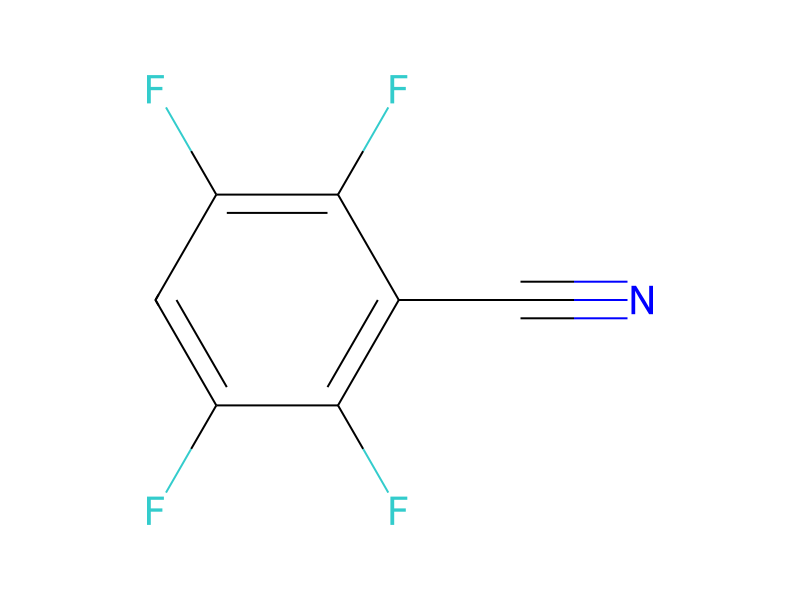

Product 1

Reagents, catalysts & solvents 1

Procedure
100 g of ethylbenzene and 3.0 g of 5% palladium/activated carbon were added to a 1000 cc stainless steel autoclave. The gas phase was sufficiently replaced with hydrogen gas, then hydrogen gas was used to apply a pressure of 0.3 MPa and make the temperature 100° C. and catalytic pretreatment was carried out for 1 hour. The gas phase was again sufficiently replaced with nitrogen, then 3.0 g of the reaction material, that is, 2,3,5,6-tetrafluoroterephthalonitrile was added. The nitrogen atmosphere was maintained, the autoclave sealed as it was at atmospheric pressure, and the temperature held at 175° C. After 3 hours, the reaction solution was analyzed by gas chromatography, whereupon the conversion of 2,3,5,6-tetrafluoroterephthalonitrile was found to be 100% and the yield of 2,3,5,6-tetrafluorobenzonitrile (based on 2,3,5,6-tetrafluoroterephthalonitrile) was 95%. At the same time, 13.4 mmol of α-methylbenzylcyanide was produced. This corresponded to 0.95 times molar amount relative to the production of 2,3,5,6-tetrafluorobenzonitrile.
Workup
- customthe temperature 100° C. and catalytic pretreatment
- temperatureThe nitrogen atmosphere was maintained
- customthe autoclave sealed as it
- customheld at 175° C
- waitAfter 3 hours
Sources & evidence
- ORD record
- ord-4362807adf114823bd7dabea1f3e1abb
- Source dataset
- uspto-grants-2000_02
- Patent number
- US06020517
Linked notes
Loading…