HuagongsheHuagongshe Chemistry Print Report · For research reference only
1-Bromo-3-chloropropane → 1-(1-Phenylethyl)-4-(3-chloropropyl)piperazine dihydrochloride
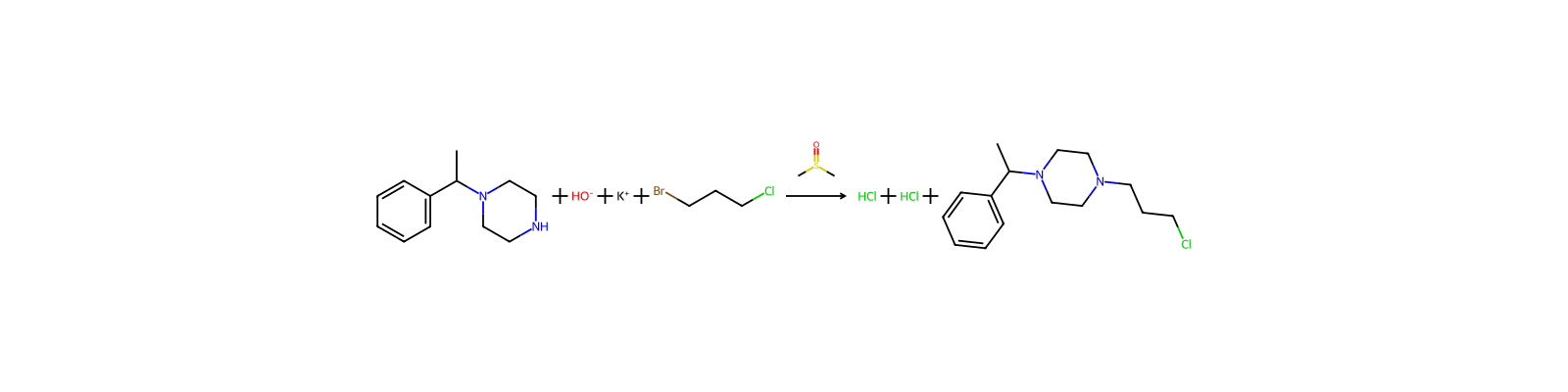
Participants
| Role | Name | HCID | Charge |
|---|---|---|---|
| Reactant | 1-Bromo-3-chloropropane | HCID 8006 | — |
| Reactant | Potassium Hydroxide | HCID 14797 | — |
| Reactant | 1-(1-Phenylethyl)piperazine | HCID 2737134 | — |
| Solvent | Dimethyl Sulfoxide | HCID 679 | — |
| Product | 1-(1-Phenylethyl)-4-(3-chloropropyl)piperazine dihydrochloride | HCID 20153170 | 409.8% |
Reaction Steps
The procedure described in Example 17(a) was followed, using 16.5 g of 1-(1-phenylethyl)piperazine, 8.0 g of potassium hydroxide, 125 ml of dimethyl sulfoxide and 9.5 g of 1-bromo-3-chloropropane. Work-up, as described above, gave 28.0 g (96% of theory) of 1-(1-phenylethyl)-4-(3-chloropropyl)piperazine dihydrochloride as a white crystalline solid.
Provenance & Evidence
| DOI | 10.6084/m9.figshare.5104873.v1 |
|---|---|
| Patent number | US04722926 |
| Source dataset | uspto-grants-1988_02 |
| ORD ID | ord-93cf949e00b544a7b8fbd151bc44a719 |
| Source note | uspto-grants-1988_02 |