HomeMCPWorkbenchSkills
HomeWorkbenchNotificationsMe
llms.txt · MCP GuidePrivacy Policy · Terms of Service · Supportv1.8.0
  1. Home
  2. /Reaction

5-Bromo-2-nitrobenzotrifluoride → HCID 22313797, compound

HRID 394864
Notes
Print preview

Reaction equation

HRID 394864 reaction equation
Br[C:2]1[CH:7]=[CH:6][C:5]([N+:8]([O-:10])=[O:9])=[C:4]([C:11]([F:14])([F:13])[F:12])[CH:3]=1.C([Sn](CCCC)(CCCC)[C:20]([O:22]CC)=[CH2:21])CCC.[Li+].[Cl-]>O1CCOCC1.C1C=CC([P]([Pd]([P](C2C=CC=CC=2)(C2C=CC=CC=2)C2C=CC=CC=2)([P](C2C=CC=CC=2)(C2C=CC=CC=2)C2C=CC=CC=2)[P](C2C=CC=CC=2)(C2C=CC=CC=2)C2C=CC=CC=2)(C2C=CC=CC=2)C2C=CC=CC=2)=CC=1>[N+:8]([C:5]1[CH:6]=[CH:7][C:2]([C:20](=[O:22])[CH3:21])=[CH:3][C:4]=1[C:11]([F:14])([F:13])[F:12])([O-:10])=[O:9]
ParticipantsProcedureWorkupSources & evidenceReaction notes

Participants

6

Reactant 3

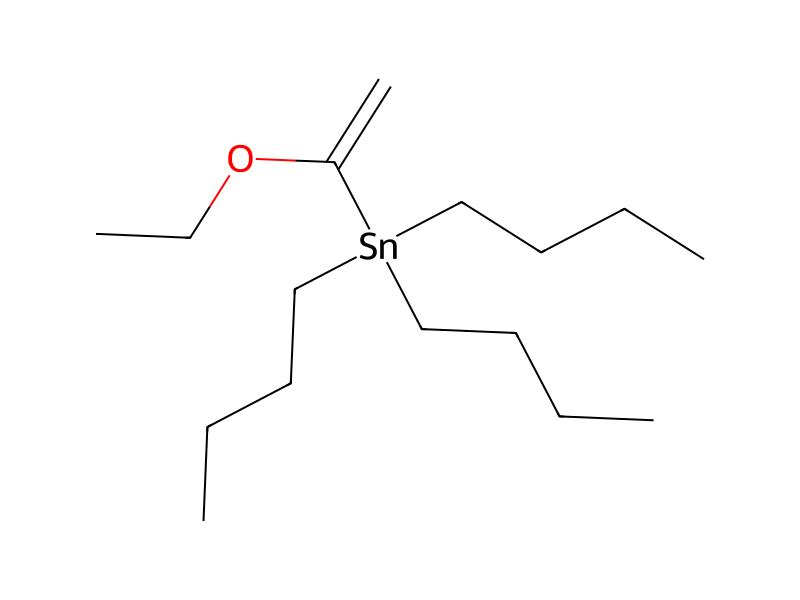
HCID 1361715-Bromo-2-nitrobenzotrifluorideHCID 433294Lithium ChlorideHCID 619414Stannane, tributyl(1-ethoxyethenyl)-

Product 1

HCID 22313797HCID 22313797, compoundYield 94%

Reagents, catalysts & solvents 2

HCID 178418397HCID 178418397, compound
Catalyst
HCID 312751,4-DioxaneSolvent

Procedure

A mixture of 4-bromo-1-nitro-2-(trifluoromethyl)benzene (1.87 g, 6.93 mmol), tributyl(1-ethoxyvinyl)tin (3.00 g, 8.31 mmol), Pd(PPh3)4 (801 mg, 0.693 mmol), and LiCl (734 mg, 17.3 mmol) in 1,4-dioxane (50 ml) was heated to reflux for 7 hours. The mixture was filtered through a pad of Celite with ethyl acetate. The filtrate was washed with water (100 ml) and brine (100 ml), dried over MgSO4, and evaporated in vacuo. To the obtained residue were added 2N HCl (20 ml) and THF (60 ml). The mixture was stirred at room temperature for 1.5 hours. Saturated aqueous NaHCO3 (60 ml) was added and the aqueous layer was extracted with ethyl acetate (100 ml×2). The combined organic layer was dried over MgSO4, and evaporated in vacuo. The resulting residue was chromatographed over silica gel with hexane/ethyl acetate (3:1) to give 1.51 g (94%) of the title compound as a white solid.

Workup

  1. temperaturewas heated
  2. temperatureto reflux for 7 hours
  3. filtrationThe mixture was filtered through a pad of Celite with ethyl acetate
  4. washThe filtrate was washed with water (100 ml) and brine (100 ml)
  5. dry with materialdried over MgSO4
  6. customevaporated in vacuo
  7. additionTo the obtained residue were added 2N HCl (20 ml) and THF (60 ml)
  8. additionSaturated aqueous NaHCO3 (60 ml) was added
  9. extractionthe aqueous layer was extracted with ethyl acetate (100 ml×2)
  10. dry with materialThe combined organic layer was dried over MgSO4
  11. customevaporated in vacuo
  12. customThe resulting residue was chromatographed over silica gel with hexane/ethyl acetate (3:1)

Sources & evidence

ORD record
ord-429db1551c74403faf7e1833ed899e9f
Source dataset
uspto-grants-2003_08
DOI
10.6084/m9.figshare.5104873.v1
Patent number
US06603008B1

Reaction notes

Loading…

On this pageParticipantsProcedureWorkupSources & evidenceReaction notes