HuagongsheHuagongshe Chemistry Print Report · For research reference only
HRID 39697Generated: October 23, 2026
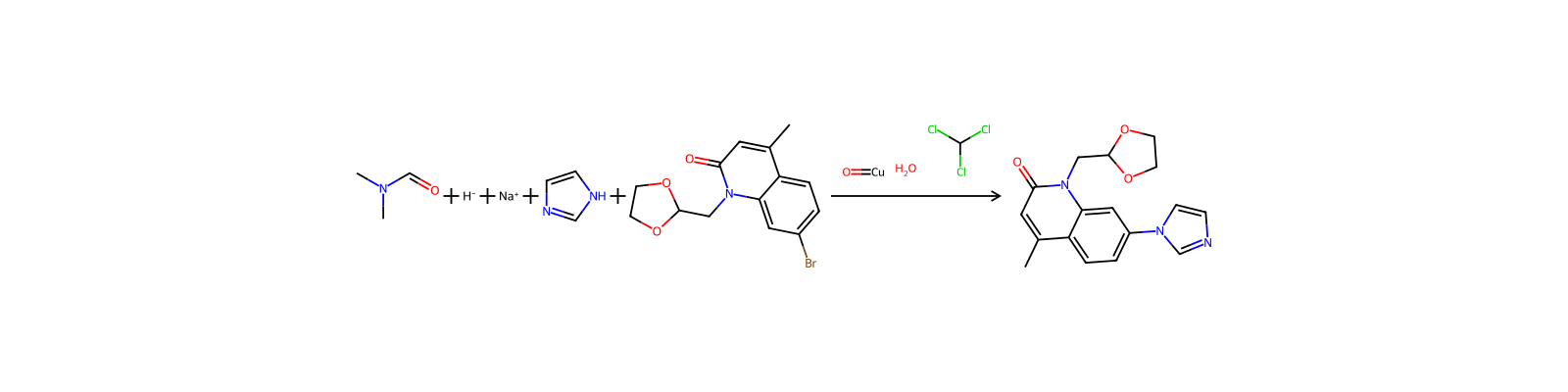
Imidazole → 1-(1,3-dioxolan-2-ylmethyl)-7-(1H-imidazol-1-yl)-4-methylquinolin-2(1H)-one
https://huagongshe.com/en/reaction/39697
Participants
| Role | Name | HCID | Charge |
|---|
| Reactant | Imidazole | HCID 795 | — |
| Reactant | Dimethylformamide | HCID 6228 | — |
| Reactant | Sodium hydride | HCID 24758 | — |
| Reactant | 7-Bromo-1-(1,3-dioxolan-2-ylmethyl)-4-methylquinolin-2(1h)-one | HCID 59398074 | — |
| Catalyst | Copper oxide | HCID 14829 | — |
| Solvent | Water | HCID 962 | — |
| Solvent | Chloroform | HCID 6212 | — |
| Product | 1-(1,3-dioxolan-2-ylmethyl)-7-(1H-imidazol-1-yl)-4-methylquinolin-2(1H)-one | HCID 59397912 | — |
Reaction Steps
To 0.7 mL of an N,N-dimethylformamide solution containing 74 mg of 60% sodium hydride, 0.14 g of imidazole was added at room temperature, and the mixture was stirred for 10 minutes. Thereto were added 0.20 g of 7-bromo-1-(1,3-dioxolan-2-ylmethyl)-4-methylquinolin-2(1H)-one and 17 mg of copper(II) oxide, and the mixture was heated to 140 to 145° C. and stirred for 40 minutes. Thereto was further added 2 mL of N,N-dimethylformamide, and the mixture was further stirred for 1 hour. The reaction mixture was cooled to room temperature, then chloroform and water were added thereto, and the insoluble material filtered off. The organic layer was separated, and the aqueous layer was extracted with chloroform. The organic layer and the extract were combined, the resultant solution was dried over anhydrous magnesium sulfate, and the solvent was removed under reduced pressure. The residue thus obtained was purified by silica gel column chromatography [eluent; chloroform:methanol=10:1] to obtain 77 mg of a brown oily substance, 1-(1,3-dioxolan-2-ylmethyl)-7-(1H-imidazol-1-yl)-4-methylquinolin-2(1H)-one.
Provenance & Evidence
| DOI | 10.6084/m9.figshare.5104873.v1 |
|---|
| Patent number | US08524738B2 |
|---|
| Source dataset | uspto-grants-2013_09 |
|---|
| ORD ID | ord-440530fd2e514d4ca5b600297af91348 |
|---|
| Source note | uspto-grants-2013_09 |
|---|