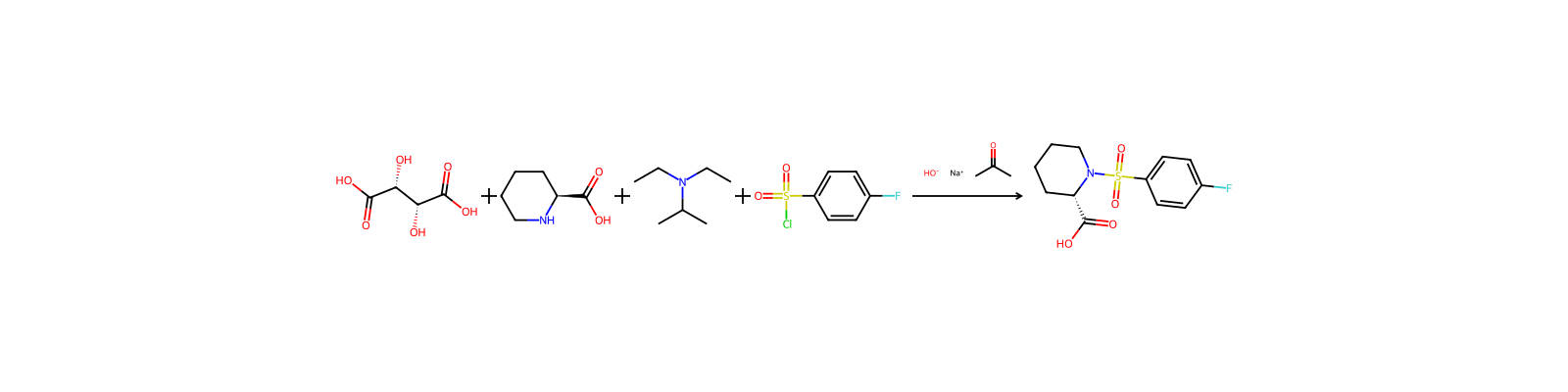
C([C@@H]([C@H](C(O)=O)O)O)(O)=O.[NH:11]1[CH2:16][CH2:15][CH2:14][CH2:13][C@H:12]1[C:17]([OH:19])=[O:18].C(N(CC)C(C)C)C.[F:28][C:29]1[CH:34]=[CH:33][C:32]([S:35](Cl)(=[O:37])=[O:36])=[CH:31][CH:30]=1>[OH-].[Na+].CC(C)=O>[F:28][C:29]1[CH:34]=[CH:33][C:32]([S:35]([N:11]2[CH2:16][CH2:15][CH2:14][CH2:13][C@H:12]2[C:17]([OH:19])=[O:18])(=[O:37])=[O:36])=[CH:31][CH:30]=1(2S)-2-Piperidinecarboxylic acid L-tartrate (10 g) [see Preparation 1] was dissolved in 1N aqueous sodium hydroxide solution (107.4 ml) and diethylisopropylamine (9.35 ml) was added followed by a solution of 4-fluorobenzenesulphonyl chloride (10.45 g) in acetone (107 ml) at 0° C. The reaction mixture was warmed to room temperature and stirred for 18 hours after which time the solvent was removed under reduced pressure and the residue diluted with 1N aqueous sodium hydroxide solution. The aqueous solution was washed with diethyl ether and acidified with concentrated hydrochloric acid. The product was extracted with ethyl acetate, the organic layers dried over magnesium sulphate and the solvent was removed under reduced pressure to afford (2S)-1-[(4-fluorophenyl)sulfonyl]-2-piperidinecarboxylic acid (9.89 g).