Acetic Anhydride → 9-Acetyl-3-bromocarbazole
HRID 403149
Reaction equation
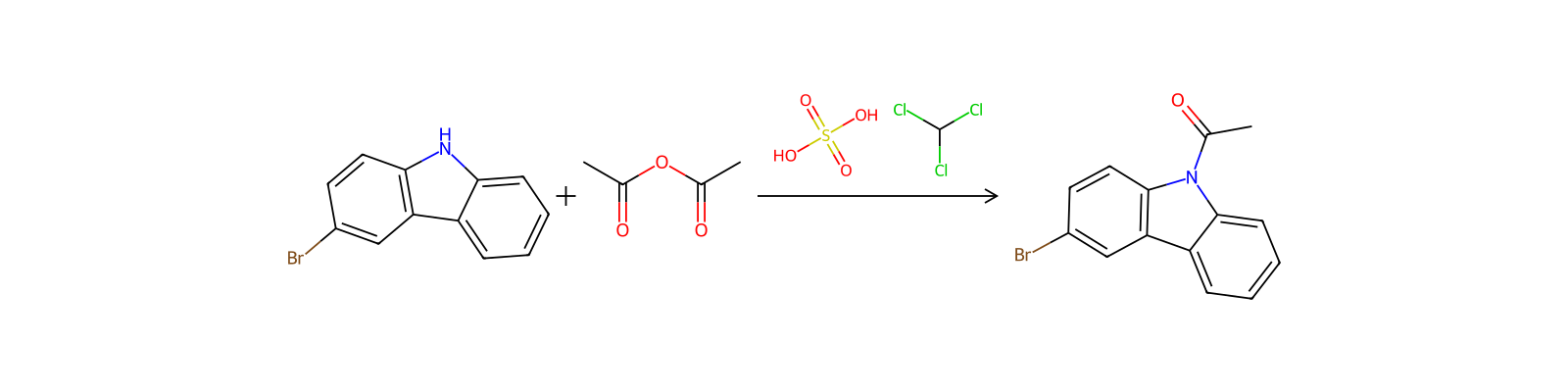
[Br:1][C:2]1[CH:3]=[CH:4][C:5]2[NH:6][C:7]3[C:12]([C:13]=2[CH:14]=1)=[CH:11][CH:10]=[CH:9][CH:8]=3.[C:15](OC(=O)C)(=[O:17])[CH3:16]>OS(O)(=O)=O.C(Cl)(Cl)Cl>[Br:1][C:2]1[CH:3]=[CH:4][C:5]2[N:6]([C:15](=[O:17])[CH3:16])[C:7]3[C:12]([C:13]=2[CH:14]=1)=[CH:11][CH:10]=[CH:9][CH:8]=3Participants
5
Reactant 2


Product 1

Reagents, catalysts & solvents 2


Procedure
A solution of 3-bromo-9H-carbazole (10.00 g, 40.6 mmol), acetic anhydride (8.30 g, 81 mmol) together with 2 drops of H2SO4 in chloroform (150 mL) was refluxed overnight. After cooling to room temperature, the solution was washed with water. Upon evaporation of the solvent, the crude product was purified by crystallization from hexane/DCM and hexane/EtOAc to yield 1-(3-bromo-9H-carbazol-9-yl)ethanone (6.1 g, 51% yield) as a light yellow solid.