HomeMCPWorkbenchSkills
HomeWorkbenchNotificationsMe
llms.txt · MCP GuidePrivacy Policy · Terms of Service · Supportv1.8.3
  1. Home
  2. /Reaction

Dichloromethane → HCID 178493984, compound

HRID 415489
Print

Reaction equation

HRID 415489 reaction equation
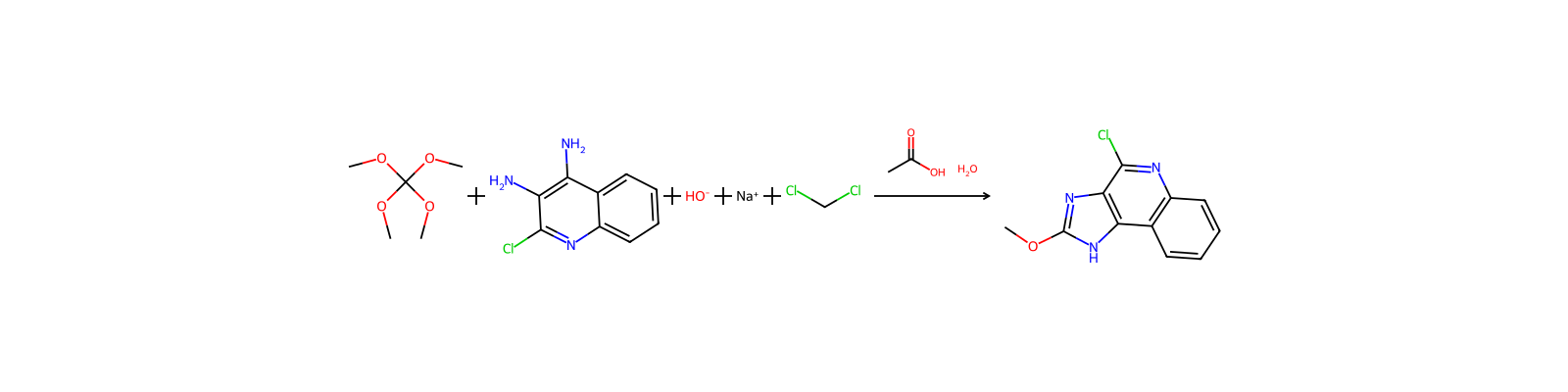
[C:1](OC)(OC)(OC)[O:2][CH3:3].[Cl:10][C:11]1[C:20]([NH2:21])=[C:19]([NH2:22])[C:18]2[C:13](=[CH:14][CH:15]=[CH:16][CH:17]=2)[N:12]=1.[OH-].[Na+].ClCCl>C(O)(=O)C.O>[Cl:10][C:11]1[C:20]2[N:21]=[C:1]([O:2][CH3:3])[NH:22][C:19]=2[C:18]2[CH:17]=[CH:16][CH:15]=[CH:14][C:13]=2[N:12]=1
ParticipantsProcedureWorkupSources & evidenceReaction notes

Participants

7

Reactant 4

HCID 6344DichloromethaneHCID 14798Sodium HydroxideHCID 74613Tetramethyl orthocarbonate2×HCID 218980332-Chloroquinoline-3,4-diamine

Product 1

HCID 178493984HCID 178493984, compound

Reagents, catalysts & solvents 2

HCID 176
Acetic Acid
Solvent
HCID 962WaterSolvent

Procedure

Tetramethyl orthocarbonate (1.24 mL, 9.3 mmol) was added to a suspension of 2-chloroquinoline-3,4-diamine, see U.S. Pat. No. 5,756,747 (Gerster) Example 30, (1.5 g, 7.75 mmol) in acetic acid (8 mL), and the reaction was stirred overnight at room temperature. An analysis by LC/MS indicated the reaction was incomplete, and additional tetramethyl orthocarbonate (0.5 equivalent) was added. The reaction was stirred overnight at room temperature and diluted with water (100 mL). The mixture was adjusted to pH 7 with the addition of 2 N aqueous sodium hydroxide. Dichloromethane (100 mL) was added to the mixture, and a precipitate formed. The precipitate was isolated by filtration to provide 1.13 g of 4-chloro-2-methoxy-1H-imidazo[4,5-c]quinoline as a gray solid.

Workup

  1. customa precipitate formed
  2. customThe precipitate was isolated by filtration

Sources & evidence

ORD record
ord-feb31a5432144a5195a0c50654f84290
Source dataset
uspto-grants-2012_01
DOI
10.6084/m9.figshare.5104873.v1
Patent number
US08088790B2

Reaction notes

On this pageParticipantsProcedureWorkupSources & evidenceReaction notes


