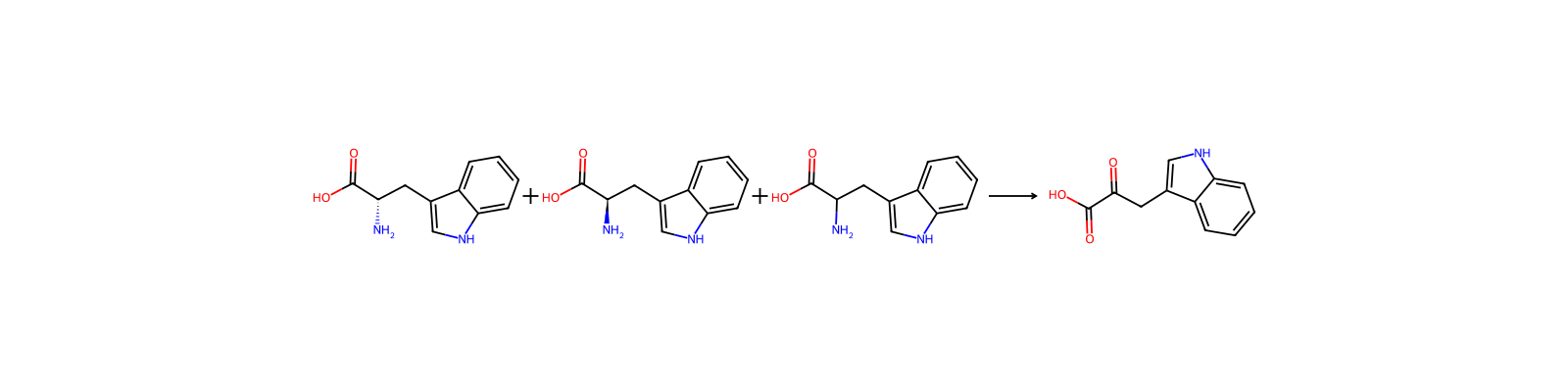
Participants
| Role | Name | HCID | Charge |
|---|
| Reactant | Dl-Tryptophan | HCID 1148 | — |
| Reactant | L-Tryptophan | HCID 6305 | — |
| Reactant | D-Tryptophan | HCID 9060 | — |
| Product | Indole-3-pyruvic acid | HCID 803 | — |
Reaction Steps
The “amino acid oxidase activity” for reaction 1 means an activity catalyzing the reaction shown in scheme (13). Generally, L-amino acid oxidase generates keto acid from the corresponding L-amino acid, while D-amino acid oxidase generates keto acid from the corresponding D-amino acid. Specifically, in accordance with the present invention, individually, a microorganism having L-amino acid oxidase activity may be used when L-tryptophan is used as the raw material, while a microorganism having D-amino acid oxidase activity may used when D-tryptophan is used as the raw material. Additionally, the preparation from DL-tryptophan is also applicable. When D- and L-amino acid oxidase is allowed to interact with DL-tryptophan, the intended indole-3-pyruvic acid may be quantitatively produced. When D- or L-amino acid oxidase interacts with DL-tryptophan, otherwise, the intended indole-3-pyruvic acid may be produced at a yield of 50%.
Provenance & Evidence
| DOI | 10.6084/m9.figshare.5104873.v1 |
|---|
| Patent number | US08535920B2 |
|---|
| Source dataset | uspto-grants-2013_09 |
|---|
| ORD ID | ord-b333953137d84ab0ae0b3b474bb38f63 |
|---|
| Source note | uspto-grants-2013_09 |
|---|