Dichloromethane → Ethyl 2-chloro-5-cyclopropylbenzoate
Reaction equation
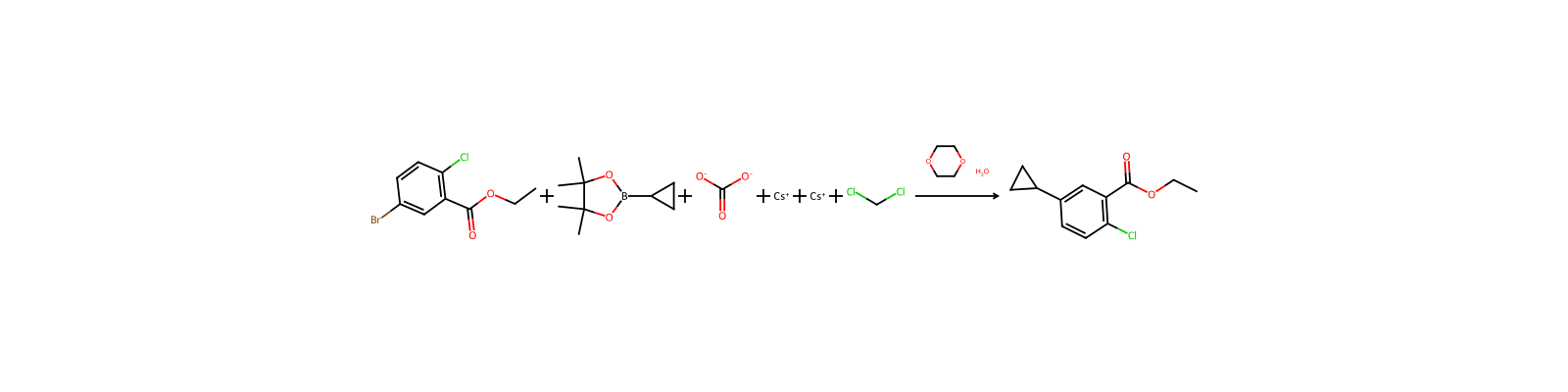
Br[C:2]1[CH:3]=[CH:4][C:5]([Cl:13])=[C:6]([CH:12]=1)[C:7]([O:9][CH2:10][CH3:11])=[O:8].[CH:14]1(B2OC(C)(C)C(C)(C)O2)[CH2:16][CH2:15]1.C([O-])([O-])=O.[Cs+].[Cs+].C(Cl)Cl>O1CCOCC1.O>[Cl:13][C:5]1[CH:4]=[CH:3][C:2]([CH:14]2[CH2:16][CH2:15]2)=[CH:12][C:6]=1[C:7]([O:9][CH2:10][CH3:11])=[O:8]Participants
7
Reactant 4




Product 1

Reagents, catalysts & solvents 2


Procedure
In a schlenck tube, a mixture of ethyl 5-bromo-2-chlorobenzoate (7.60 mmol, 2 g), 2-cyclopropyl-4,4,5,5-tetramethyl-1,3,2-dioxaborolane (7.59 mmol, 1.3 g), Cs2CO3 (18.97 mmol, 6.18 g), PdCl2dppf.CH2Cl2 (0.76 mmol, 0.620 g) in dioxane (70 ml) and water (15 ml) was heated for 2 hours at 110° C., under argon atmosphere. The solvent was evaporated and the mixture was extracted between ethyl acetate and water. The crude mixture was purified by chromatography over SiO2 eluting hexane/ethyl acetate mixtures and affording 1.5 g (yield 92%) of the expected product.
Workup
- customThe solvent was evaporated
- extractionthe mixture was extracted between ethyl acetate and water
- customThe crude mixture was purified by chromatography over SiO2
- washeluting hexane/ethyl acetate mixtures
Sources & evidence
- ORD record
- ord-3f7a1f5c32b142a0a07a8e28ccfefc8f
- Source dataset
- uspto-grants-2013_09
- Patent number
- US08536165B2
Reaction notes
Loading…