HomeMCPWorkbenchSkills
HomeWorkbenchNotificationsMe
llms.txt · MCP GuidePrivacy Policy · Terms of Service · Supportv1.8.3
  1. Home
  2. /Reaction

Sodium Carbonate → 6-(1H-indol-4-yl)-1H-indazol-4-amine

HRID 42238
Print

Reaction equation

HRID 42238 reaction equation
Br[C:2]1[CH:3]=[C:4]([NH2:11])[C:5]2[CH:6]=[N:7][NH:8][C:9]=2[CH:10]=1.CC1(C)C(C)(C)OB([C:20]2[CH:28]=[CH:27][CH:26]=[C:25]3[C:21]=2[CH:22]=[CH:23][NH:24]3)O1.C(=O)([O-])[O-].[Na+].[Na+]>O1CCOCC1.O.ClCCl.C1C=CC(P(C2C=CC=CC=2)[C-]2C=CC=C2)=CC=1.C1C=CC(P(C2C=CC=CC=2)[C-]2C=CC=C2)=CC=1.Cl[Pd]Cl.[Fe+2].C(Cl)Cl>[NH:24]1[C:25]2[C:21](=[C:20]([C:2]3[CH:3]=[C:4]([NH2:11])[C:5]4[CH:6]=[N:7][NH:8][C:9]=4[CH:10]=3)[CH:28]=[CH:27][CH:26]=2)[CH:22]=[CH:23]1
ParticipantsConditionsProcedureWorkupSources & evidenceReaction notes

Participants

8

Reactant 3

HCID 10340Sodium CarbonateHCID 113224711H-Indole-4-boronic acid, pinacol esterHCID 247280636-Bromo-1H-indazol-4-amine

Product 1

HCID 582680196-(1H-indol-4-yl)-1H-indazol-4-amineYield 109.3%

Reagents, catalysts & solvents 4

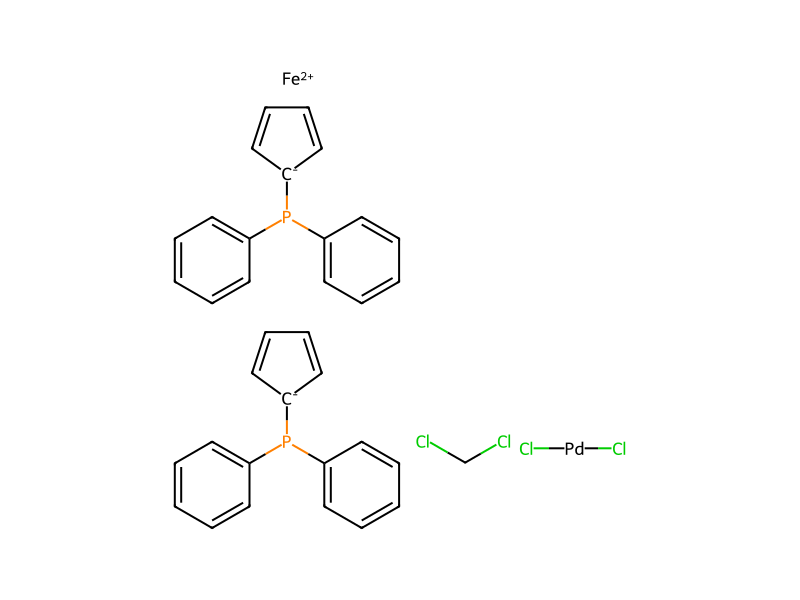
HCID 178418807HCID 178418807, compound
Catalyst
HCID 962WaterSolvent
HCID 6344DichloromethaneSolvent
HCID 312751,4-DioxaneSolvent

Conditions

Temperature
115 °C

Procedure

6-Bromo-1H-indazol-4-amine (10 g, available from Sinova Inc.) and 4-(4,4,5,5-tetramethyl-1,3,2-dioxaborolan-2-yl)-1H-indole (16.05 g, available from Frontier Scientific, Europe Ltd) were dissolved in 1,4-dioxane (60 ml) and water (60 ml). 2M sodium carbonate (70.7 ml) and Pd(dppf)Cl2-DCM adduct (1.93 g) were added and the mixture was heated at 115° C. for 18 hr. The reaction mixture was diluted with dichloromethane (200 ml) and the organic and aqueous layers were separated by hydrophobic frit. The aqueous layer was extracted with further quantities of dichloromethane (2×200 ml), using a hydrophobic frit to separate the layers. The organic layers were combined and silica (80 g) was added. The solvent was removed in vacuo to give a crude material that was purified by chromatography on silica gel (750 g cartridge, Flashmaster II) eluting with 0-100% ethyl acetate in cyclohexane over 60 minutes. The oil was dried in vacuo on a drying rack overnight. The resultant yellow foam was dissolved in dichloromethane (3×400 ml), removing the solvent in vacuo after each dissolution. Ethyl acetate (50 ml) was then added and the solvent was removed in vacuo. The solid obtained was dried in a vacuum oven to afford the title compound (12.8 g) as a yellow foam.


Workup

  1. customthe organic and aqueous layers were separated by hydrophobic frit
  2. extractionThe aqueous layer was extracted with further quantities of dichloromethane (2×200 ml)
  3. customto separate the layers
  4. additionsilica (80 g) was added
  5. customThe solvent was removed in vacuo
  6. customto give a crude material that
  7. customwas purified by chromatography on silica gel (750 g cartridge, Flashmaster II)
  8. washeluting with 0-100% ethyl acetate in cyclohexane over 60 minutes
  9. customThe oil was dried in vacuo on a drying rack overnight
  10. dissolutionThe resultant yellow foam was dissolved in dichloromethane (3×400 ml)
  11. customremoving the solvent in vacuo
  12. dissolutionafter each dissolution
  13. additionEthyl acetate (50 ml) was then added
  14. customthe solvent was removed in vacuo
  15. customThe solid obtained
  16. customwas dried in a vacuum oven

Sources & evidence

ORD record
ord-3930262a914743309a99998ff69ffe44
Source dataset
uspto-grants-2013_09
DOI
10.6084/m9.figshare.5104873.v1
Patent number
US08536169B2

Reaction notes

On this pageParticipantsConditionsProcedureWorkupSources & evidenceReaction notes