Reaction equation
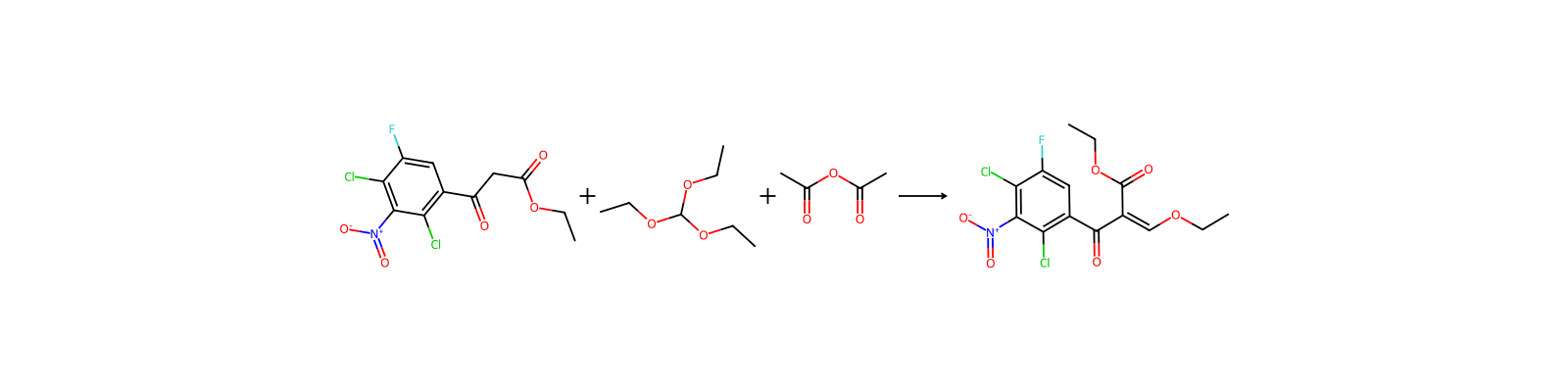
[Cl:1][C:2]1[C:15]([N+:16]([O-:18])=[O:17])=[C:14]([Cl:19])[C:13]([F:20])=[CH:12][C:3]=1[C:4]([CH2:6][C:7]([O:9][CH2:10][CH3:11])=[O:8])=[O:5].[CH:21](OCC)(OCC)[O:22][CH2:23][CH3:24].C(OC(=O)C)(=O)C>>[Cl:1][C:2]1[C:15]([N+:16]([O-:18])=[O:17])=[C:14]([Cl:19])[C:13]([F:20])=[CH:12][C:3]=1[C:4]([C:6](=[CH:21][O:22][CH2:23][CH3:24])[C:7]([O:9][CH2:10][CH3:11])=[O:8])=[O:5]Participants
4



Procedure
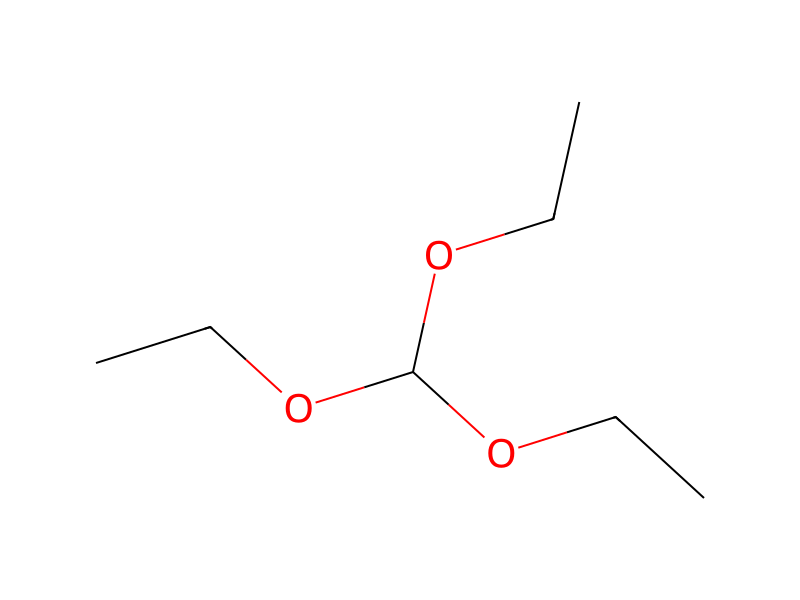
244.8 g of ethyl (2,4-dichloro-5-fluoro-3-nitrobenzoyl)-acetate are heated at 150°-160° C. with 166 g of triethyl orthoformate and 185 g of acetic anhydride for 3 hours. The mixture is then concentrated in vacuo and 270 g of ethyl benzoyl-ethoxy-acrylate are obtained as an oily residue.
Workup
- concentrationThe mixture is then concentrated in vacuo and 270 g of ethyl benzoyl-ethoxy-acrylate
- customare obtained as an oily residue
Sources & evidence
- ORD record
- ord-cc19d9ec45394266839c589e505a7929
- Source dataset
- uspto-grants-1988_02
- Patent number
- US04725595
Linked notes
Loading…