Reaction equation

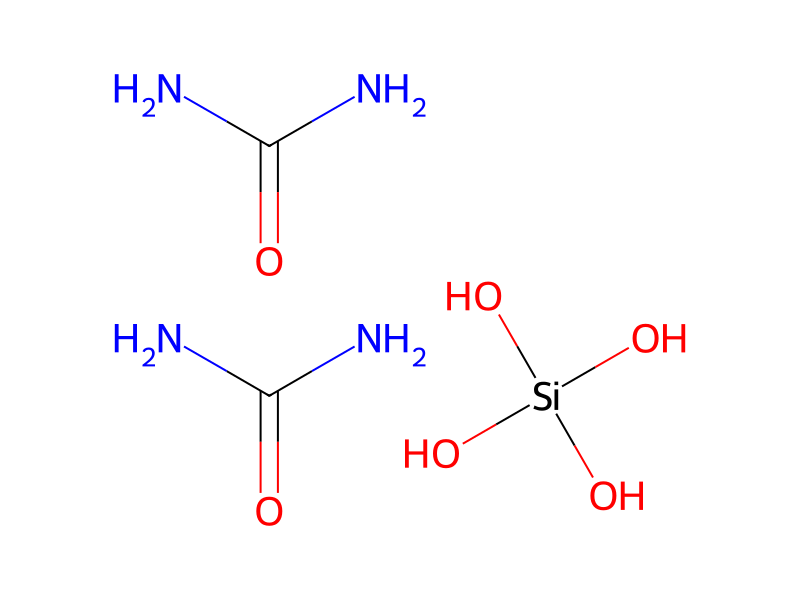
[Si:1]([OH:5])([OH:4])([OH:3])[OH:2].[NH2:6][C:7]([NH2:9])=[O:8].[NH2:10][C:11]([NH2:13])=[O:12].C1N2CN3CN(C2)CN1C3>>[Si:1]([OH:5])([OH:4])([OH:3])[OH:2].[NH2:6][C:7]([NH2:9])=[O:8].[NH2:10][C:11]([NH2:13])=[O:12].[CH2:7]=[O:8]Participants


Procedure
Clay is reacted with sulfuric acid, thereby producing metasilicic acid, which is recovered by filtration. About one mol of said metasilicic acid is mixed with 2 mols of urea, heated to 90° to 150° C. for 20 to 30 minutes, thereby producing white granules of diurea silicate. The said diurea silicate is added to an aqueous solution of hexamethylene tetramine in the ratio of 1:1.5 mols, heated to 70° to 110° C. for 20 to 90 minutes, thereby producing a clear thick solution of poly (formaldehyde diurea silicate) resin, and, upon further heating, a white resin is produced. The said white resin is soluble in acetic acid and produces a clear solution; the unreacted silicic acid is precipitated. The solution of poly (formaldehyde diurea silicate) resin forms a clear tough coating on wood.
Workup
- temperature1.5 mols, heated to 70° to 110° C. for 20 to 90 minutes
Sources & evidence
- ORD record
- ord-16dcd62f7e1b46a39abc2464f27df1eb
- Source dataset
- uspto-grants-1979_10
- Patent number
- US04169930
Linked notes
Loading…