Reaction equation

C=C.[CH:3](=[C:5]1[CH2:10][CH:9]2[CH2:11][CH:6]1[CH:7]=[CH:8]2)[CH3:4].[CH2:12]=[CH:13][CH3:14]>ClC1C=CC=CC=1Cl>[CH2:3]=[CH2:4].[CH2:12]=[CH:13][CH3:14].[CH:3](=[C:5]1[CH2:10][CH:9]2[CH2:11][CH:6]1[CH:7]=[CH:8]2)[CH3:4]Participants
5
Reactant 3

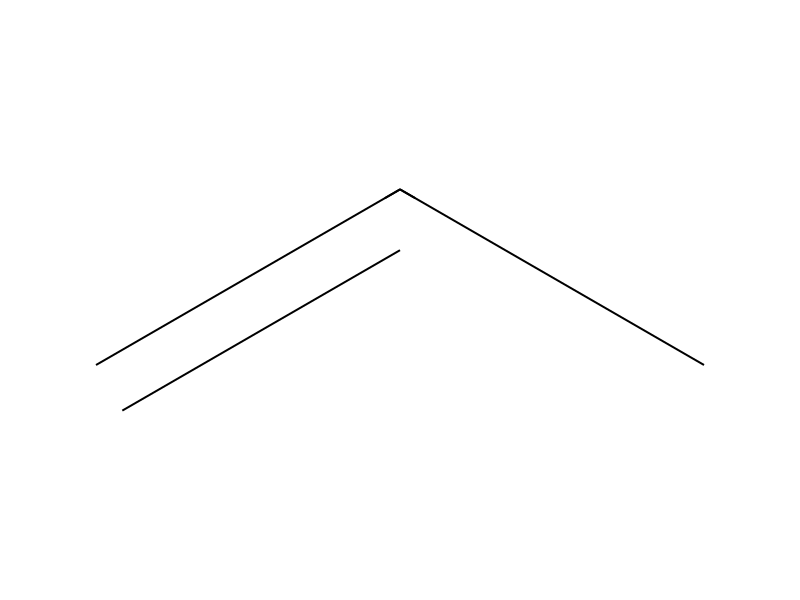

Product 1

Reagents, catalysts & solvents 1

Procedure
The procedure of Comparative Example 2 was followed except that the catalyst used was 5×10⁻⁷ mol of rac-[(ind)Et2PBCl2(ind)ZrCl2] activated with 5×10⁻³ mol of MAO. The internal pressure was raised by 2 bar with ethylene. The polymerization took place in the presence of 1 g of ethylidenenorbornene (ENB). The terpolymer formed (1.5 g) contained 63 wt. % of ethylene, 35 wt. % of propylene and 2 wt. % of ENB. The intrinsic viscosity in ortho-dichlorobenzene at 140° C. was 1.86 dl/g. The GC measurement in o-Cl2-benzene at 140° C. gave Mw=460 kg/mol and Mn=203 kg/mol. The DSC measurement in the 2nd heating indicated an amorphous polymer with a glass transition temperature Tg of −50° C.
Workup
- customThe terpolymer formed (1.5 g)
- customat 140° C.
- temperatureThe DSC measurement in the 2nd heating
Sources & evidence
- ORD record
- ord-7b7bbb7d1b9844e683b89a20cd34c55f
- Source dataset
- uspto-grants-2003_12
- Patent number
- US06657027B2
Linked notes
Loading…