HuagongsheHuagongshe Chemistry Print Report · For research reference only
HRID 433Generated: October 23, 2026
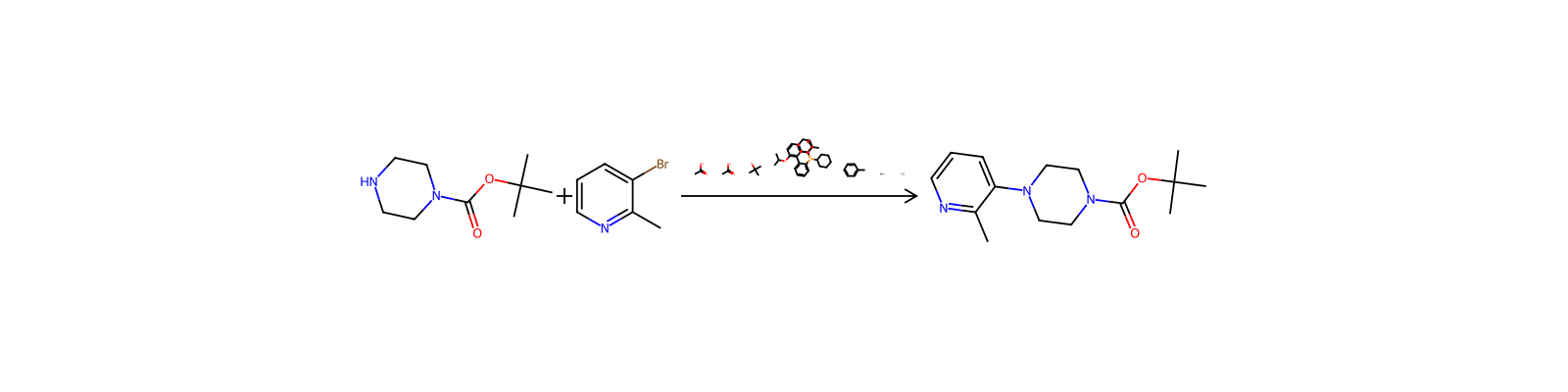
tert-Butyl piperazine-1-carboxylate → Tert-butyl 4-(2-methylpyridin-3-yl)piperazine-1-carboxylate
https://huagongshe.com/en/reaction/433
Participants
| Role | Name | HCID | Charge |
|---|
| Reactant | tert-Butyl piperazine-1-carboxylate | HCID 143452 | — |
| Reactant | 3-Bromo-2-methylpyridine | HCID 1201003 | — |
| Reagent | Sodium t-butoxide | HCID 23676156 | — |
| Catalyst | Palladium (II) acetate | HCID 4144353 | — |
| Catalyst | 2-Dicyclohexylphosphino-2',6'-diisopropoxybiphenyl | HCID 16217985 | — |
| Solvent | Toluene | HCID 1140 | — |
| Product | Tert-butyl 4-(2-methylpyridin-3-yl)piperazine-1-carboxylate | HCID 68106327 | 82.86% |
Reaction Steps
RuPhos (0.543 g, 1.16 mmol) and palladium (II) acetate (0.131 g, 0.58 mmol) were suspended in toluene (15 mL) at ambient temperature. The resulting mixture was degassed and purged several times and warmed to 50°C under nitrogen for 20 mins. In a separate vessel were mixed 3-bromo-2-methylpyridine (2 g, 11.63 mmol), tert-butyl 4-(2-methylpyridin-3-yl)piperazine-1-carboxylate (2.67 g, 83 %), sodium tertbutoxide (1.676 g, 17.44 mmol) and toluene. The mixture was degassed and purged with nitrogen several times and warmed to 50°C. The catalyst solution was added to the reaction vessel and the resulting mixture degassed and purged wtih nitrogen. The reaction was heated at 100°C overnight. The reaction mixture was allowed to cool to ambient temperature and filtered through GF/F paper, washing with MeOH. The filtrate was concentrated to provide the crude material. This was purified by flash silica chromatography, elution gradient 20 to 70% EtOAc in heptane. Pure fractions were evaporated to dryness to afford tert-butyl 4-(2-methylpyridin-3-yl)piperazine-1-carboxylate (2.67 g, 83 %) as a pale yellow oil.
Provenance & Evidence
| Source dataset | 750 AstraZeneca ELN dataset |
|---|
| ORD ID | ord-4147e405915e4ea7b4607546c536b535 |
|---|
| Source note | 750 AstraZeneca ELN dataset |
|---|