1-Methyl-5-nitro-1H-imidazole-2-carbaldehyde → 3-(5-Nitro-1-methyl-2-imidazolyl)-s-triazolo[4,3-b]pyridazine
Reaction equation
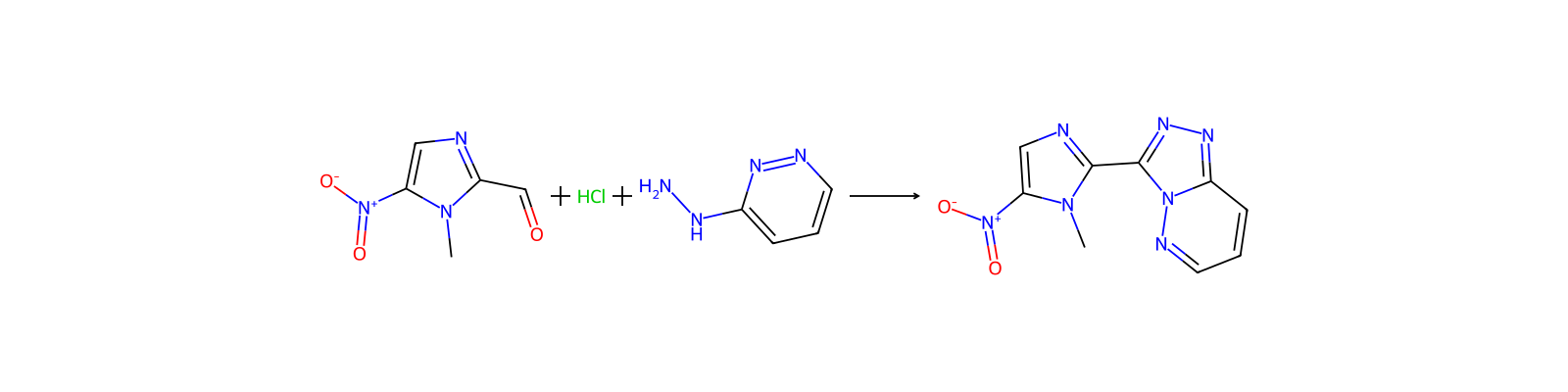
[N+:1]([C:4]1[N:8]([CH3:9])[C:7]([CH:10]=O)=[N:6][CH:5]=1)([O-:3])=[O:2].Cl.[NH:13]([C:15]1[N:16]=[N:17][CH:18]=[CH:19][CH:20]=1)[NH2:14]>>[N+:1]([C:4]1[N:8]([CH3:9])[C:7]([C:10]2[N:16]3[N:17]=[CH:18][CH:19]=[CH:20][C:15]3=[N:13][N:14]=2)=[N:6][CH:5]=1)([O-:3])=[O:2]Participants
3


Procedure
4 g. lead tetraacetate were suspended in 40 ml. glacial acetic acid, 1.5 g. of the hydrazone obtained from 1.55 g. 5-nitro-1-methyl-imidazole-2-aldehyde and 1.1 g. 3-hydrazinopyridazine hydrochloride (prepared by heating for 30 minutes in 20 ml. 50% aqueous methanol at 50° C. and subsequent neutralization with sodium acetate) were added, while stirring at 50° - 60° C., the reaction mixture further stirred for 15 minutes, considerably evaporated in a vacuum, the resultant crystals filtered off with suction, triturated with water and dried for 2 hours in a vacuum at 120° C., 1.05 g. of the desired 3-(5-nitro-1-methyl-2 -imidazolyl)-s-triazolo[4,3-b]pyridazine being obtained, which has a melting point of 235° - 237° C.