Reaction equation
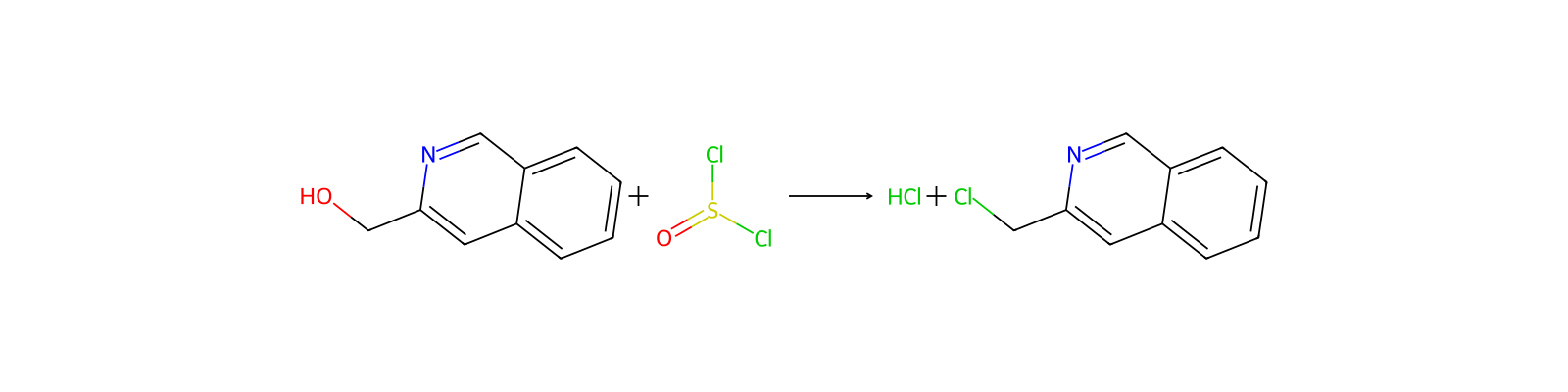
O[CH2:2][C:3]1[N:4]=[CH:5][C:6]2[C:11]([CH:12]=1)=[CH:10][CH:9]=[CH:8][CH:7]=2.S(Cl)([Cl:15])=O>>[ClH:15].[Cl:15][CH2:2][C:3]1[N:4]=[CH:5][C:6]2[C:11]([CH:12]=1)=[CH:10][CH:9]=[CH:8][CH:7]=2Participants
3



Conditions
- Temperature
- 5 °C
Procedure
3-Hydroxymethylisoquinoline (110 g) is added to thionyl chloride (130 cc), whilst cooling so as to keep the temperature between 25° and 30° C. The reaction mixture is then heated to the reflux temperature at a rate which is such that the evolution of gas is not excessive. The mixture is heated under reflux for 90 minutes (until the evolution of gas ceases), and then for a further 30 minutes. It is then cooled to 5° C. with ice, the slurry formed is filtered and the solid is washed with diethyl ether. 3-Chloromethylisoquinoline hydrochloride (136 g), melting at 202° C., is obtained.
Workup
- temperaturewhilst cooling so as
- customthe temperature between 25° and 30° C
- temperatureThe reaction mixture is then heated to the reflux temperature at a rate which
- temperatureThe mixture is heated
- temperatureunder reflux for 90 minutes (until the evolution of gas ceases), and then for a further 30 minutes
- customthe slurry formed
- filtrationis filtered
- washthe solid is washed with diethyl ether
Sources & evidence
- ORD record
- ord-fd911da2821140ef80f91ad7a78d59d9
- Source dataset
- uspto-grants-1981_04
- Patent number
- US04261993
Linked notes
Loading…