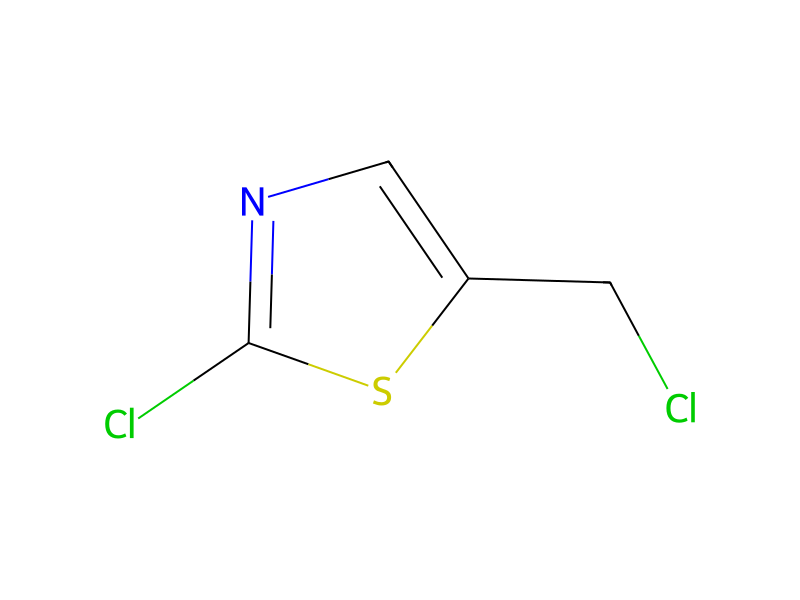
[CH2:1]([NH:8][C:9]1[CH2:13][O:12][C:11](=[O:14])[CH:10]=1)[C:2]1[CH:7]=[CH:6][CH:5]=[CH:4][CH:3]=1.[OH-].[Na+].[Cl:17][C:18]1[S:19][C:20]([CH2:23]Cl)=[CH:21][N:22]=1>C(COC)OC>[CH2:1]([N:8]([CH2:23][C:20]1[S:19][C:18]([Cl:17])=[N:22][CH:21]=1)[C:9]1[CH2:13][O:12][C:11](=[O:14])[CH:10]=1)[C:2]1[CH:3]=[CH:4][CH:5]=[CH:6][CH:7]=16.3 g of 4-(benzylamino)furan-2(5H)-one (Example 16) are initially charged in 75 ml of dimethoxyethane at room temperature. Subsequently, 1.3 g of sodium hydroxide are added and, at 40° C., 34.4 g of a 15% solution of 2-chloro-5-(chloromethyl)-1,3-thiazole in dimethoxyethane are metered in. The mixture is stirred at 50° C. for a further 6 h. The solvent is substantially removed under reduced pressure and the residue is admixed with 50 ml of water and 50 ml of methylene chloride. The organic phase is removed, and the aqueous phase is extracted once again with 50 ml of methylene chloride. The combined methylene chloride phases are dried over sodium sulphate and the solvent is removed under reduced pressure. 6.9 g of 4-{benzyl[(2-chloro-1,3-thiazol-5-yl)methyl]amino}furan-2(5H)-one are obtained (this corresponds to 71% yield).