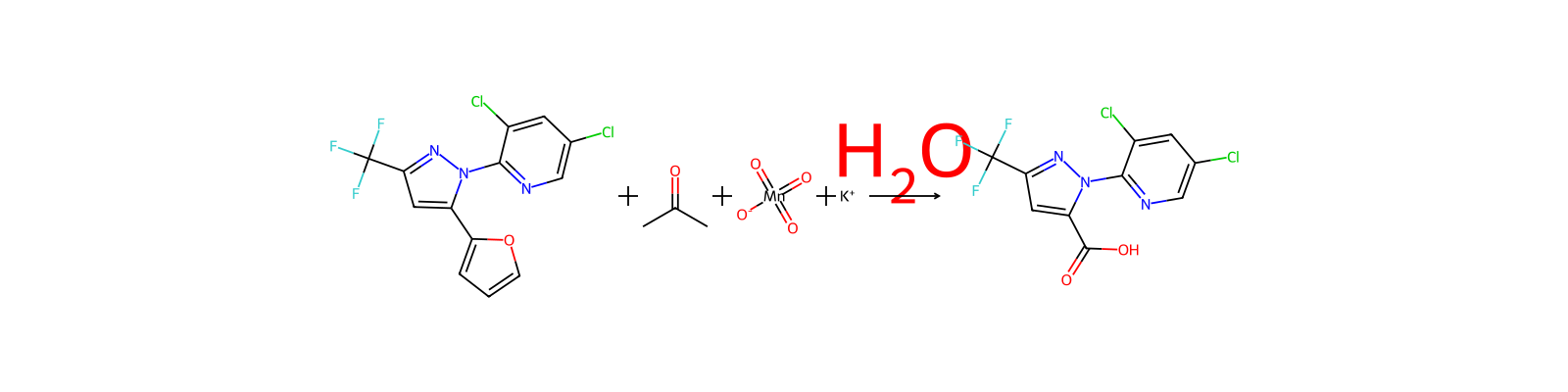
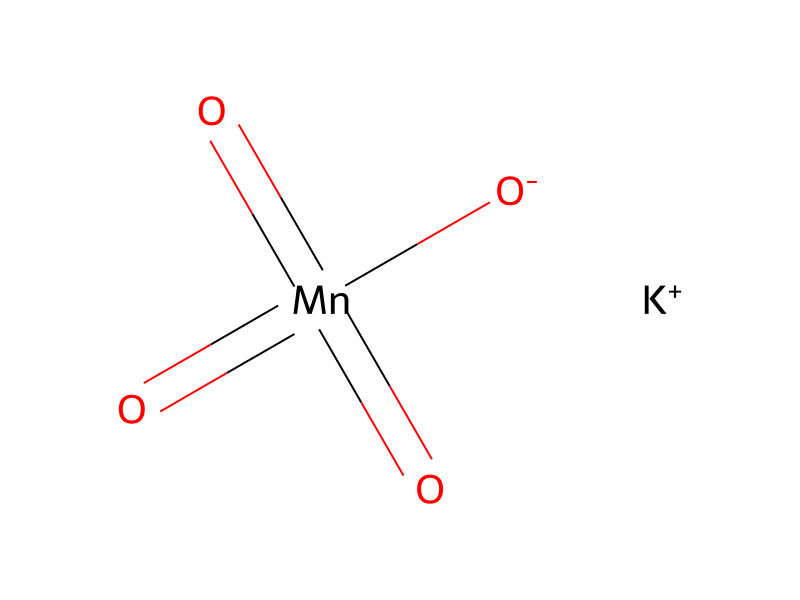
[Cl:1][C:2]1[C:3]([N:9]2[C:13]([C:14]3[O:15]C=CC=3)=[CH:12][C:11]([C:19]([F:22])([F:21])[F:20])=[N:10]2)=[N:4][CH:5]=[C:6]([Cl:8])[CH:7]=1.CC(C)=[O:25].[Mn]([O-])(=O)(=O)=O.[K+]>O>[Cl:1][C:2]1[C:3]([N:9]2[C:13]([C:14]([OH:15])=[O:25])=[CH:12][C:11]([C:19]([F:22])([F:21])[F:20])=[N:10]2)=[N:4][CH:5]=[C:6]([Cl:8])[CH:7]=1To a 100 mL flask, 3,5-dichloro-2-(5-(furan-2-yl)-3-(trifluoromethyl)-1H-pyrazol-1-yl)pyridine (1.47 g, 4.22 mmol), acetone (10 mL) and a solution (10 mL) of potassium permanganate (3.33 g, 21.1 mmol) in water were added. The reaction mixture was heated to 65° C. for 4 hours and cooled to room temperature, then isolated via filtration, a cake is obtained. The cake was washed with hot solution of potassium hydroxide. To the filtrate was added ethyl acetate (80 mL), water (100 mL) and partitioned. The aqueous layer was acidified with concentrated hydrochloric acid to pH of 2-3, and extracted with ethyl acetate (200 mL). The organic extracts were washed with saturated brine (100 mL), dried over anhydrous magnesium sulfate and concentrated by rotary evaporator to give the product (0.80 g) as yellow oil in 58% yield.
Loading…