Reaction equation

[CH3:1][C:2]1C(C)(C)C(CC=O)C[CH:3]=1.[S:12](=[O:16])(=[O:15])([OH:14])[OH:13].[OH2:17].[O-2:18].[Cr+6:19].[O-2:20].[O-2]>CC(C)=O>[CH3:1][C:2]([CH3:3])=[O:17].[OH:15][S:12]([OH:16])(=[O:14])=[O:13].[O:17]=[Cr:19](=[O:20])=[O:18]Participants
Reactant 4




Product 1
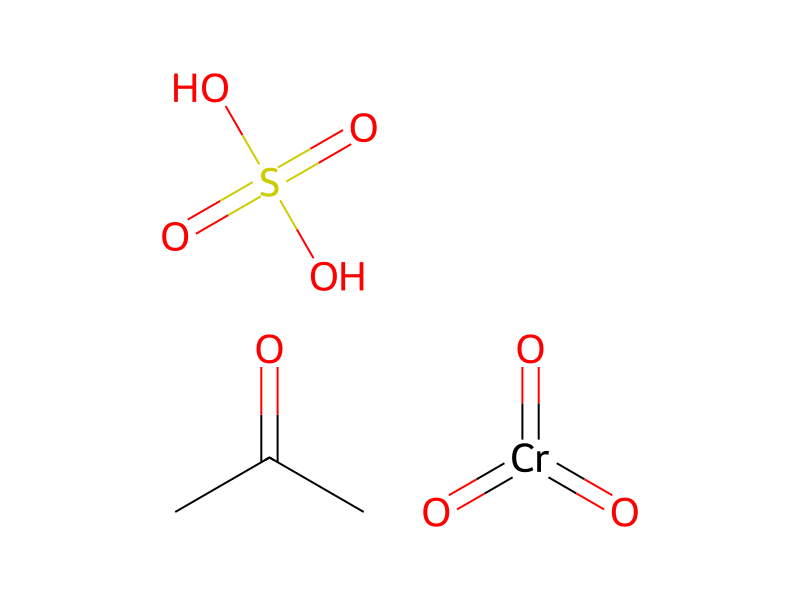
Reagents, catalysts & solvents 1

Conditions
- Temperature
- 0 °C
Procedure
A solution was made of α-campholenic aldehyde (200 g) in acetone (2 liters) and cooled to 0° C. Jones reagent was prepared from 115 ml conc. sulfuric acid, 500 ml water and 134 g of chromium (VI) oxide. The reagent (400 ml) was added to the solution at 0° C. over a period of 30 minutes. After an additional 15 minutes at 0° C. the acetone was removed by decantation and the residual chromium salts were washed with an additional 200 ml acetone. The combined acetone solution was concentrated to 1 liter, diluted with 10% aqueous sodium hydroxide (1 liter) and washed with CH2Cl2 (2×1 liter). The aqueous phase was acidified with 25% sulfuric acid and extracted with CH2Cl2 (2×1 liter). Concentration of the CH2Cl2 solution yielded an oil (145 g) which was distilled under reduced pressure to give 116 g of a yellowish liquid; bp 121° C. @ 2.2 mm Hg; analysis: 98% (CW 20M fused silica column, 180° C.) α-campholenic acid.
Workup
- customAfter an additional 15 minutes at 0° C. the acetone was removed by decantation
- washthe residual chromium salts were washed with an additional 200 ml acetone
- concentrationThe combined acetone solution was concentrated to 1 liter
- additiondiluted with 10% aqueous sodium hydroxide (1 liter)
- washwashed with CH2Cl2 (2×1 liter)
- extractionextracted with CH2Cl2 (2×1 liter)
Sources & evidence
- ORD record
- ord-3109fbb8a15643999dd6b5f8be02d0e9
- Source dataset
- uspto-grants-1985_10
- Patent number
- US04547315
Linked notes
Loading…