Reaction equation
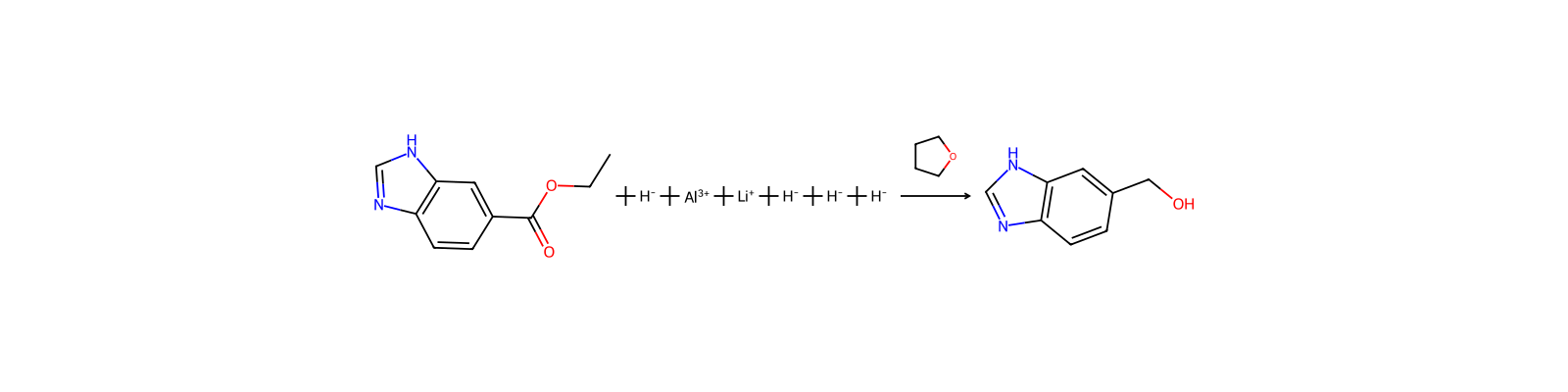
C([O:3][C:4]([C:6]1[CH:14]=[CH:13][C:9]2[N:10]=[CH:11][NH:12][C:8]=2[CH:7]=1)=O)C.[H-].[Al+3].[Li+].[H-].[H-].[H-]>O1CCCC1>[OH:3][CH2:4][C:6]1[CH:14]=[CH:13][C:9]2[N:10]=[CH:11][NH:12][C:8]=2[CH:7]=1Participants
Reactant 2


Product 1
Reagents, catalysts & solvents 1

Procedure
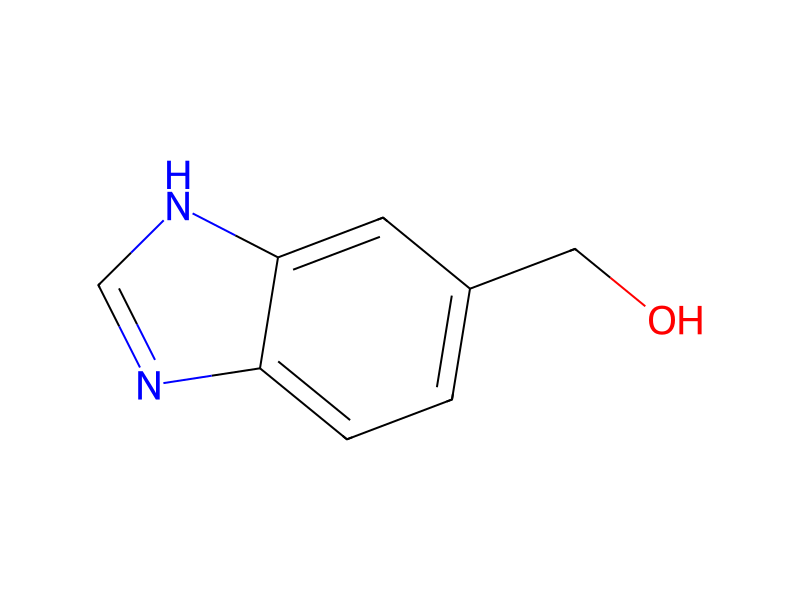
According to a method similar to that described in Zhur. Obschei Khim., vol. 32, pp 835-41 (1953), 3,4-diaminobenzoic acid was prepared. A formic acid solution (200 ml) of 3,4-diaminobenzoic acid (8 g) thus prepared was refluxed for 4 hrs to yield 5-carboxybenzimidazole.hydrochloride (8.9 g). The carboxylic acid (8.9 g) was refluxed with heating for 3.5 hrs in a mixture of sulfuric acid (4 ml) and absolute ethanol (140 ml) to yield 5-ethoxycarbonylbenzimidazole (mp. 93°-94° C., 7.8 g). An anhydrous tetrahydrofuran solution (20 ml) of the ester (7.5 g) was added to an anhydrous tetrahydrofuran suspension (50 ml) of lithium aluminium hydride (6.5 g) while cooling. The mixture was stirred for 3 hrs at room temperature to yield 5-hydroxymethylbenzimidazole (mp. 128.4° C., 3.62 g). A 47% aqueous hydrobromic acid solution (33 ml) containing the benzimidazole derivative (2.2 g) and cysteamine hydrochloride (1.9 g) was refluxed with heating for 7 hrs to yield 5-[(2-aminoethyl)thiomethyl]benzimidazole.2 hydrobromide (mp. 224°-225° C., 4.2 g).
Workup
- temperaturewhile cooling
Sources & evidence
- ORD record
- ord-74ae9b1a2ca648fb8ea828081fade12f
- Source dataset
- uspto-grants-1985_10
- Patent number
- US04550118
Linked notes
Loading…