Reaction equation
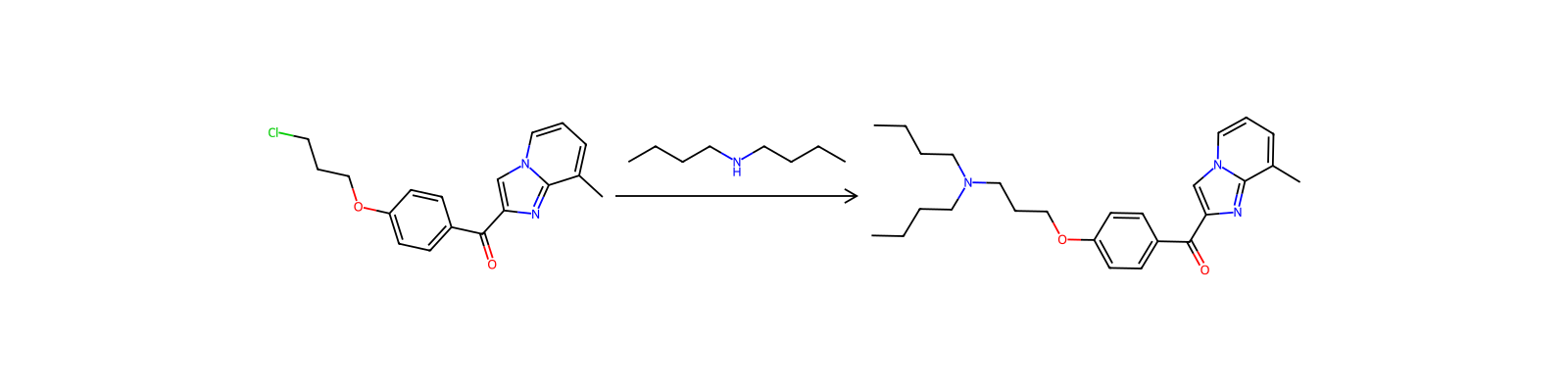
Cl[CH2:2][CH2:3][CH2:4][O:5][C:6]1[CH:23]=[CH:22][C:9]([C:10]([C:12]2[N:13]=[C:14]3[C:19]([CH3:20])=[CH:18][CH:17]=[CH:16][N:15]3[CH:21]=2)=[O:11])=[CH:8][CH:7]=1>C(NCCCC)CCC>[CH2:12]([N:13]([CH2:2][CH2:3][CH2:4][O:5][C:6]1[CH:23]=[CH:22][C:9]([C:10]([C:12]2[N:13]=[C:14]3[C:19]([CH3:20])=[CH:18][CH:17]=[CH:16][N:15]3[CH:21]=2)=[O:11])=[CH:8][CH:7]=1)[CH2:14][CH2:19][CH2:18][CH3:17])[CH2:10][CH2:9][CH3:8]Participants
Reactant 1

Product 1

Reagents, catalysts & solvents 1

Procedure
A mixture of 2-(4-chloropropoxybenzoyl)-8-methylimidazo-[1,2-a]pyridine (2,4 g, 6.0 mmol) in dibutylamine (30 ml) was stirred at reflux for 8 hours. The excess dibutylamine was removed by distillation and the resulting oil was flash chromatographed (silica gel, acetone) to give the free base of the title compound (2.5 g, 100% yield) as a thick oil. The HCl salt was prepared by dropwise addition of concentrated hydrochloric acid to a solution of the title compound in methanol, concentrated and recrystallized from methanol-acetone, mp 159° C. to 161° C. IR(KBr): 3420, 1650cm-1. MS: 421 (M+). 1H NMR (CD3OD): δ8.89 (s, 1H), 8.72 (d, J=6.6 Hz, 1H), 8.15 (d, J=8.9 Hz, 2H), 7.89 (d, J=7.3 Hz, 1H), 7.48 (t, J=6.9 Hz, 1H), 7.21 (d, J= 8.9 Hz, 2H), 4.29 (t, J=7 Hz, 2H), 3.26 (m, 6H), 2.73 (s, 3H), 2.33 (m, 2H), 1.79-1.35 (m, 8H), 1.02 (m, 6H).
Workup
- temperatureat reflux for 8 hours
- customThe excess dibutylamine was removed by distillation
- customchromatographed (silica gel, acetone)
Sources & evidence
- ORD record
- ord-2f581a38daf94834b468162a35cf8171
- Source dataset
- uspto-grants-1988_02
- Patent number
- US04727145
Linked notes
Loading…