HuagongsheHuagongshe Chemistry Print Report · For research reference only
HRID 4761Generated: October 26, 2026
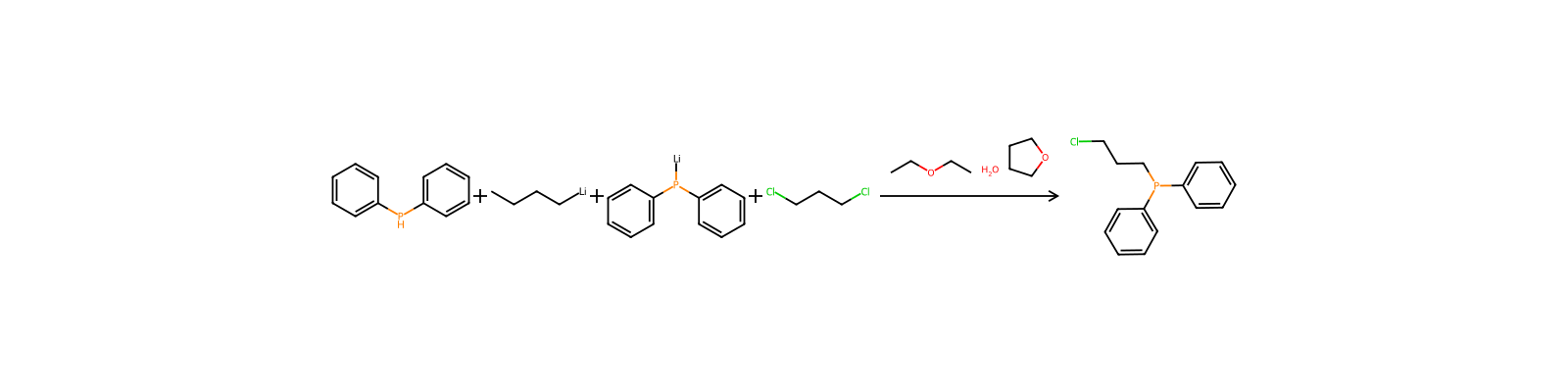
1,3-Dichloropropane → Phosphine, (3-chloropropyl)diphenyl-
https://huagongshe.com/reaction/4761
Participants
| Role | Name | HCID | Charge |
|---|
| Reactant | 1,3-Dichloropropane | HCID 8881 | — |
| Reactant | Diphenylphosphine | HCID 70017 | — |
| Reactant | Butyllithium | HCID 178418339 | — |
| Reactant | HCID 178418495 | HCID 178418495 | — |
| Solvent | Water | HCID 962 | — |
| Solvent | Diethyl Ether | HCID 3283 | — |
| Solvent | Tetrahydrofuran | HCID 8028 | — |
| Product | Phosphine, (3-chloropropyl)diphenyl- | HCID 608029 | — |
Reaction Steps
To a 500 mL round bottom flask there was added 400 mL of dry tetrahydrofuran followed by 0.081 mole of HPPh2. The mixture was cooled to 0° C. and 0.081 mole of n-butyl lithium was slowly added to generate LiPPh2 ; this was slowly warmed to room temperature and stirred for about one hour. The solution was transferred to a dropping funnel and added dropwise to a flask containing 100 mL of 1,3-dichloropropane dissolved in 100 mL of diethyl ether. After stirring overnight the mixture was hydrolyzed with 25 mL of water. The organic layer was separated and the solvent removed by vacuum to leave Ph2P(CH2)3Cl that was stored under nitrogen until needed.
Provenance & Evidence
| DOI | 10.6084/m9.figshare.5104873.v1 |
|---|
| Patent number | US04727200 |
|---|
| Source dataset | uspto-grants-1988_02 |
|---|
| ORD ID | ord-12421d0797394bc59f5eb474f7a37fd6 |
|---|
| Source note | uspto-grants-1988_02 |
|---|