HuagongsheHuagongshe Chemistry Print Report · For research reference only
HRID 481998Generated: October 23, 2026
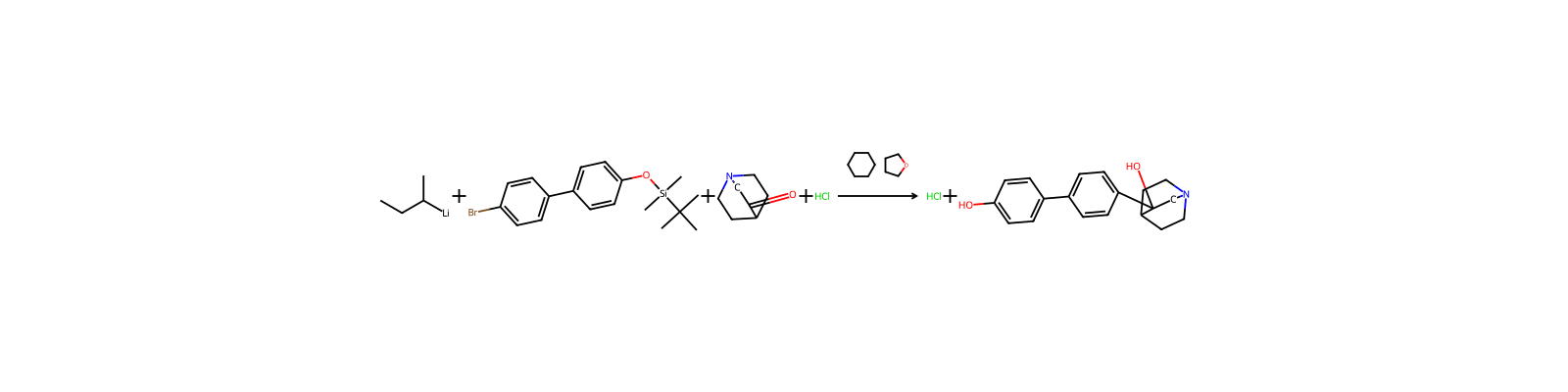
Hydrochloric Acid → 3-(4'-Hydroxybiphenyl-4-yl)-3-hydroxy-quinuclidine hydrochloride
https://huagongshe.com/en/reaction/481998
Participants
| Role | Name | HCID | Charge |
|---|
| Reactant | Hydrochloric Acid | HCID 313 | — |
| Reactant | 3-Quinuclidinone | HCID 19507 | — |
| Reactant | ({4'-Bromo-[1,1'-biphenyl]-4-yl}oxy)(tert-butyl)dimethylsilane | HCID 3765121 | — |
| Reactant | CID 53628100 | HCID 178418400 | — |
| Solvent | Tetrahydrofuran | HCID 8028 | — |
| Solvent | Cyclohexane | HCID 8078 | — |
| Product | 3-(4'-Hydroxybiphenyl-4-yl)-3-hydroxy-quinuclidine hydrochloride | HCID 19065047 | — |
Reaction Steps
A solution of sec-butyllithium in cyclohexane (7.4 ml, 1.3M) was added dropwise, with stirring, to a solution of 4-bromo-4'-(tert-butyldimethylsilyloxy)biphenyl (2.9 g) in dry tetrahydrofuran (30 ml) under an atmosphere of argon at -78° C. The mixture was stirred for 5 minutes and a solution of quinuclidin-3-one (0.9 g) in dry tetrahydrofuran (12 ml) was then added over a period of 2 minutes. The mixture was stirred at -78° C. for a further 30 minutes and the mixture then allowed to warm to room temperature over 2 hours. Aqueous 2M hydrochloric acid (18 ml) was added to the reaction mixture, whilst keeping the temperature of the reaction mixture below 10° C. The aqueous layer was separated and washed with diethyl ether (2×20 ml) before the addition of excess sodium hydroxide solution (density 1.35 g/cm3) to pH 14. The mixture was extracted with warm ethyl acetate (50° C.) and the ethyl acetate phase separated, dried (Na2SO4) and evaporated. The residue was dissolved in dry tetrahydrofuran (20 ml) and added to a solution of tetrabutyl ammonium fluoride in tetrahydrofuran (1.6 ml, 1.0M). The mixture was stirred at room temperature for 2 hours. The tetrahydrofuran was evaporated, an excess of saturated ethereal hydrogen chloride solution was added to precipitate a solid which was crystallised from methanol/ethyl acetate to give as a colourless solid, 3-(4'-hydroxybiphenyl-4-yl)-3-hydroxy-quinuclidine hydrochloride (0.93 g), m.p. 270°-271° C., microanalysis, found: C, 66.5; H, 6.5; N, 4.1%; C19H21NO2.HCl.0.66H2O requires: C, 66.5: H, 6.8: N, 4.1%; NMR ([CD3 ]2SO): 1.4-1.6(1H, m), 1.7-1.9(2H, m), 2.3-2.4(2H, m), 3.1-3.4(5H, m), 3.8-3.9(1H, d), 5.9(1H, s), 6.9-7.5(4H, d of d), 7.6(4H, s), 9.6(1H, s); m/Z 296 (M+H).
Provenance & Evidence
| DOI | 10.6084/m9.figshare.5104873.v1 |
|---|
| Patent number | US05792777 |
|---|
| Source dataset | uspto-grants-1998_08 |
|---|
| ORD ID | ord-1d5ac452d5414b35b9cd25f93c64cfd3 |
|---|
| Source note | uspto-grants-1998_08 |
|---|