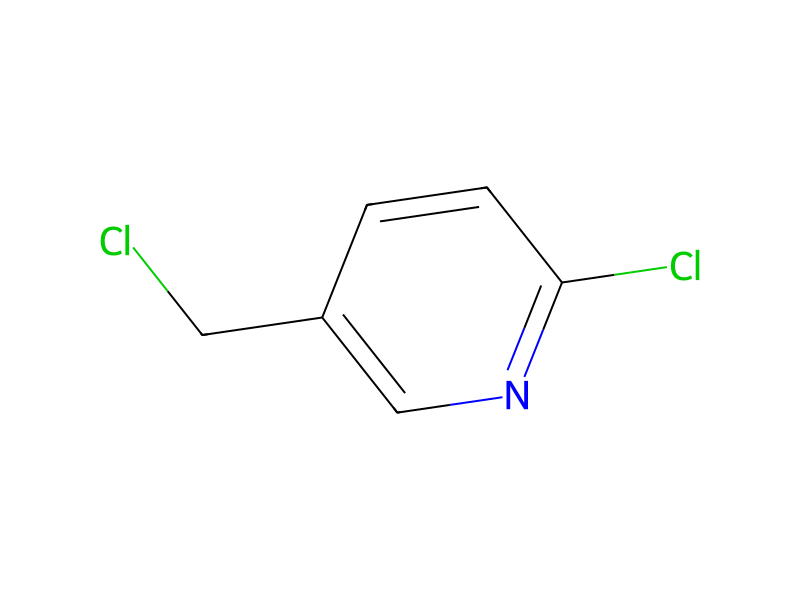
2-Chloro-5-(chloromethyl)pyridine → 2-[(6-Chloropyridin-3-yl)methyl]-1H-isoindole-1,3(2H)-dione
Reaction equation

[Cl:1][C:2]1[CH:7]=[CH:6][C:5]([CH2:8]Cl)=[CH:4][N:3]=1.[C:10]1(=[O:20])[NH:14][C:13](=[O:15])[C:12]2=[CH:16][CH:17]=[CH:18][CH:19]=[C:11]12.[K]>ClCCl>[Cl:1][C:2]1[N:3]=[CH:4][C:5]([CH2:8][N:14]2[C:13](=[O:15])[C:12]3=[CH:16][CH:17]=[CH:18][CH:19]=[C:11]3[C:10]2=[O:20])=[CH:6][CH:7]=1Participants
4
Reactant 2

Product 1

Reagents, catalysts & solvents 1

Conditions
- Temperature
- 160 °C
Procedure
2-Chloro-5-chloromethylpyridine (8.1 g, 0.05 mol) and potassium phthalimide (10.2 g, 0.055 mol) were mixed together at ambient temperature (20° C.) and the resulting mixture was then heated with stirring at 160° C. for 12 hours. The reaction mixture was then cooled to ambient temperature (20° C.) and dichloromethane was added until most of the solid residue had dissolved. The dichloromethane extract was then washed with water (2×150 ml) and brine (1×200 ml), dried using magnesium sulphate, and evaporated under reduced pressure to give a light-brown solid. The title product, N-(6-chloro-3-pyridylmethyl) phthalimide, was isolated from this solid by flash chromatography using silica gel, 230 to 400 US mesh (0.062 mm to 0.037 mm), with 10% v/v ether/ dichloromethane as eluent, as a buff solid (10.70 g, 78.5%), mp 140° to 142° C.