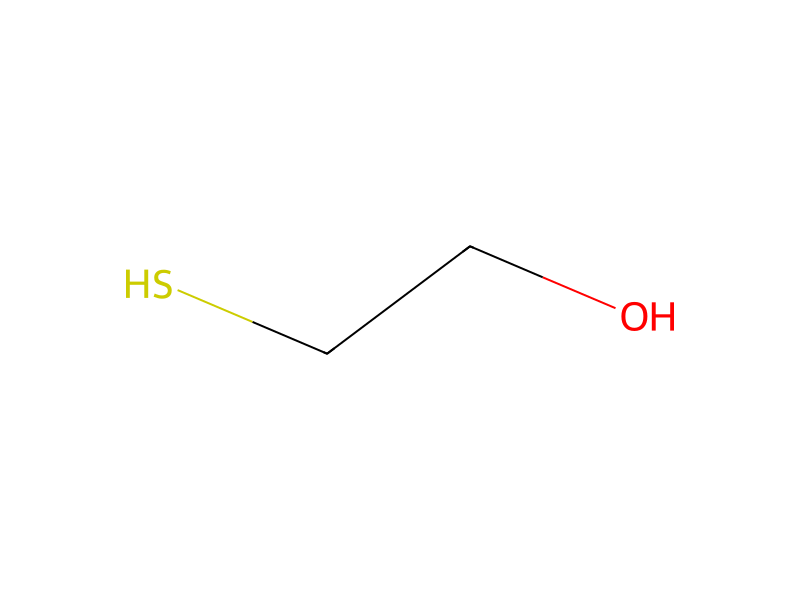
2-Mercaptoethanol → Ristianol
HRID 485049
Reaction equation

C[O-].[Na+].Cl.[N:5]1[CH:10]=[CH:9][C:8]([CH2:11]Cl)=[CH:7][CH:6]=1.[SH:13][CH2:14][CH2:15][OH:16]>C(O)C>[OH:16][CH2:15][CH2:14][S:13][CH2:11][C:8]1[CH:9]=[CH:10][N:5]=[CH:6][CH:7]=1Participants
5
Reactant 3


Product 1

Reagents, catalysts & solvents 1

Procedure
Under a nitrogen atmosphere, sodium methoxide (170.1 g., 3.15 moles, 2.1 equiv.) was dissolved in 2.7 1. of absolute ethanol, and the stirred solution cooled in an ice bath. Solid 4-picolyl chloride hydrochloride (97%, 253.6 g., 1.5 moles, 1 equiv.) was added portionwise over approximately 15 minutes. A solution of 2-mercaptoethanol (128.9 g., 1.65 moles), dissolved in 300 ml. of ethanol, was then added dropwise over approximately 30 minutes. The reaction was allowed to warm to room temperature and stirred for 21.5 hours. Diatomaceous earth was added to the reaction mixture, which after brief stirring, was filtered. The filter cake was repulped 2× 1500 ml. of absolute ethanol, the filtrates were combined with the original filtrate, and the combined ethanol solution evaporated to a solid-containing oil (approximately 290 g.). The oil was dissolved in 1500 ml. of hot chloroform, treated with activated carbon, filtered, reconcentrated to oil (274 g.) and chromatographed on 1.5 kg. of silcia gel in a 10 cm. diameter column using chloroform as eluant. Fractions of approximately 3.5 1. were taken. Fractions 3 to 18 were combined, concentrated to oil, the oil taken up in approximately 1 1. of ethyl acetate and evaporated to yield relatively pure 4-(2-hydroxyethylthiomethyl)pyridine [195.7 g., ir (film): 3.17, 3.51, 3.58, 6.27, 9.45 and 12.27μ; pnmr/CDCl3 /TMS/delta: 8.63-8.42 (m, 2H), 7.38-7.18 (m, 2H), 3.73 (t, 2H), 3.72 (s, 2H), 2.98 (s, broad, 1H) and 2.63 (t, 2H) ppm]. On standing, product prepared by this procedure slowly crystallized (m.p. 47°-48° C.).