Reaction equation

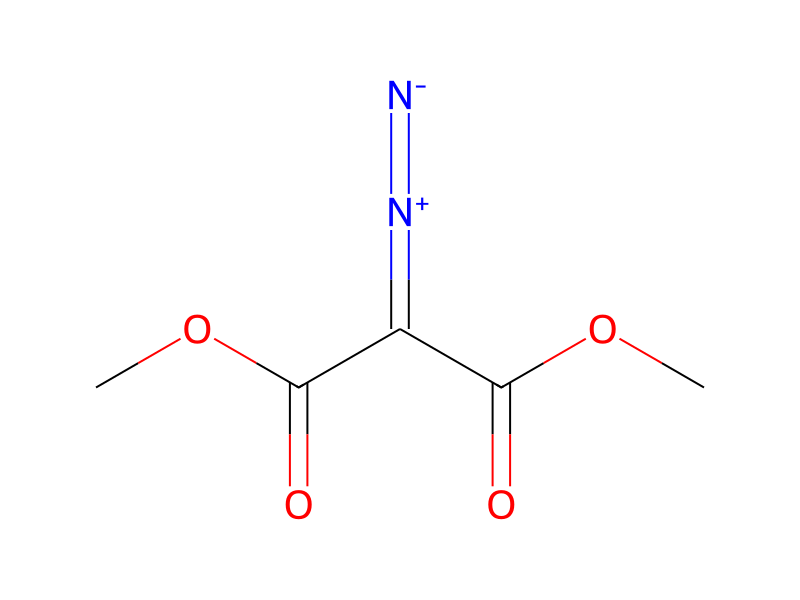
[C:1]1([C:7]#[C:8][C:9]2[CH:14]=[CH:13][CH:12]=[CH:11][CH:10]=2)[CH:6]=[CH:5][CH:4]=[CH:3][CH:2]=1.[N+](=[C:17]([C:22]([O:24][CH3:25])=[O:23])[C:18]([O:20][CH3:21])=[O:19])=[N-]>CC(CC(C)=O)=O.CC(CC(C)=O)=O.[Cu]>[C:1]1([C:7]2[C:17]([C:22]([O:24][CH3:25])=[O:23])([C:18]([O:20][CH3:21])=[O:19])[C:8]=2[C:9]2[CH:10]=[CH:11][CH:12]=[CH:13][CH:14]=2)[CH:6]=[CH:5][CH:4]=[CH:3][CH:2]=1Participants



Conditions
- Temperature
- 120 °C
Procedure
A 100 millilater round-bottom flask was equipped with a magnetic stirrer and reflux condenser with N2 inlet. The flask was charged with 25.0 grams (0.140 mole) of diphenylacetylene and 140 milligrams of cupric acetylacetonate. The mixture was heated to 120° C. using an oil bath and 8.85 grams (0.056 mole) of dimethyl diazomalonate was added over 24 hours using a syringe pump. When all of the dimethyl diazomalonate had been added, heating at 120° C. was continued for 8 hours. The diphenylacetylene was distilled off under vacuum, boiling point 170° C./19 Mm. The residue was purified by flash chromatography eluting with 75:25 hexane-ethyl acetate to give 4.65 grams (0.015 mole) of the desired product as a white solid. NMR analysis of the product indicated the following:
Workup
- customA 100 millilater round-bottom flask was equipped with a magnetic stirrer
- temperaturereflux condenser with N2 inlet
- temperatureheating at 120° C.
- distillationThe diphenylacetylene was distilled off under vacuum, boiling point 170° C./19 Mm
- customThe residue was purified by flash chromatography
- washeluting with 75:25 hexane-ethyl acetate
Sources & evidence
- ORD record
- ord-66d65d320ac04264a52aa06affbf25cc
- Source dataset
- uspto-grants-1994_03
- Patent number
- US05292937
Linked notes
Loading…