Reaction equation

[N+](=[C:3]([C:8]([O:10][CH3:11])=[O:9])[C:4]([O:6][CH3:7])=[O:5])=[N-].[CH3:12][C:13](=[C:15]([CH3:17])[CH3:16])[CH3:14]>[Hg]>[CH3:12][C:13]1([CH3:14])[C:15]([CH3:17])([CH3:16])[C:3]1([C:8]([O:10][CH3:11])=[O:9])[C:4]([O:6][CH3:7])=[O:5]Participants
4
Reactant 2

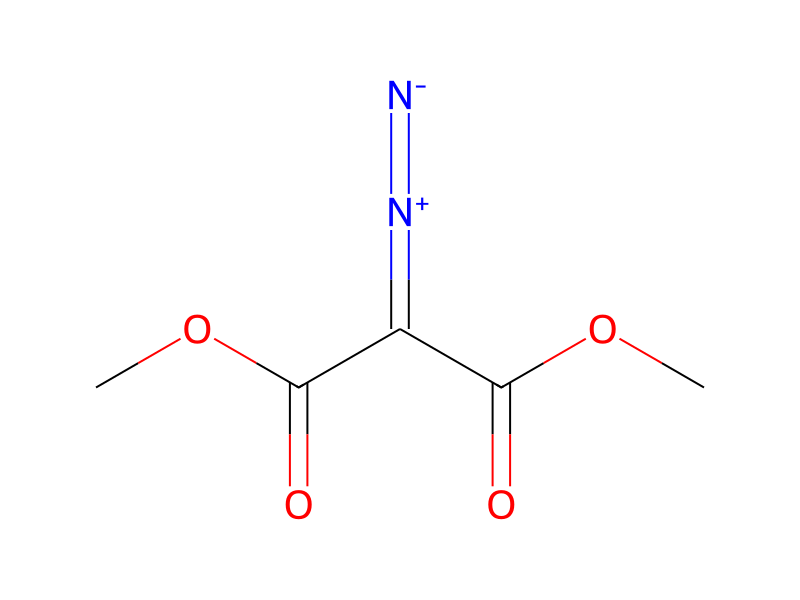
Product 1

Reagents, catalysts & solvents 1

Procedure
A mixture of 20.0 grams (0.13 mole) of dimethyl diazomalonate and 164.35 grams (1.95 moles) of 2,3-dimethyl-2-butene was photolyzed at room temperature for a period of approximately 47 hours in the presence of a 100-watt Hanovia mercury lamp. Most of the unreacted 2,3-dimethyl-2-butene was removed by distillation, at atmospheric pressure, to a head temperature of 73° C. and the still residue was subjected to flash chromatography on a silica gel column to give 9.00 grams (0.04 mole) of dimethyl 2,2,3,3-tetramethylcyclopropanedicarboxylate. NMR analysis of the product indicated the following:
Workup
- customMost of the unreacted 2,3-dimethyl-2-butene was removed by distillation, at atmospheric pressure, to a head temperature of 73° C.
Sources & evidence
- ORD record
- ord-00b6f8f1372f4d36a710da393e7c716f
- Source dataset
- uspto-grants-1994_03
- Patent number
- US05292937
Linked notes
Loading…