Reaction equation

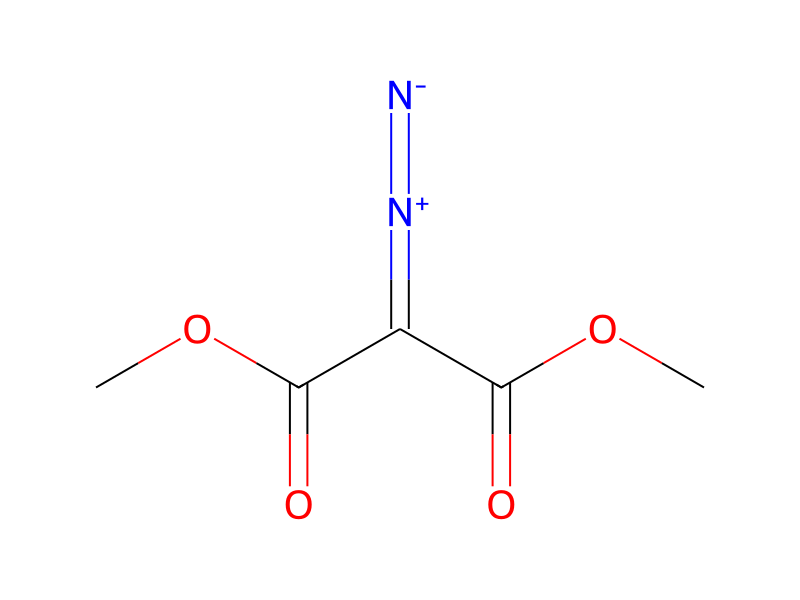
[CH3:1][CH2:2][CH2:3][C:4]#[C:5][CH2:6][CH2:7][CH3:8].[N+](=[C:11]([C:16]([O:18][CH3:19])=[O:17])[C:12]([O:14][CH3:15])=[O:13])=[N-]>CC(CC(C)=O)=O.CC(CC(C)=O)=O.[Cu]>[CH2:3]([C:4]1[C:11]([C:16]([O:18][CH3:19])=[O:17])([C:12]([O:14][CH3:15])=[O:13])[C:5]=1[CH2:6][CH2:7][CH3:8])[CH2:2][CH3:1]Participants



Procedure
4-Octyne and dimethyl diazomalonate were reacted in the presence of cupric acetylacetonate in a manner similar to that described in Example XCVII Part A to give dimethyl 2,3-di-n-propyl-2-cyclopropene-1,1-dicarboxylate which was saponified to give mono-methyl 2,3-di-n-propyl-2-cyclopropene-1,1-dicarboxylate and worked up by the general procedure of Example XCVII Part B. Reaction of the latter mono-methyl ester in sequence with ethyl chloroformate and 4-bromo-2-methylaniline, in the presence of potassium carbonate and 18-crown-6, in a manner similar to that described in Example XCIX Part B to give methyl 1-(4-bromo-2-methylphenyl-aminocarbonyl)-2,3-di-n-propyl-2-cyclopropenecarboxylate having a melting point of 52° C.-54° C. Elemental analysis of the product indicated the following:
Sources & evidence
- ORD record
- ord-7840ca65ebe64e8c9362cac1c38f4194
- Source dataset
- uspto-grants-1994_03
- Patent number
- US05292937
Linked notes
Loading…