Reaction equation

[CH3:1][O:2][C:3]1[CH:4]=[C:5]2[C:10](=[CH:11][CH:12]=1)[N:9]=[C:8]([CH3:13])[CH:7]=[CH:6]2.[Br:14]N1C(=O)CCC1=O>C(#N)C>[Br:14][C:4]1[C:3]([O:2][CH3:1])=[CH:12][CH:11]=[C:10]2[C:5]=1[CH:6]=[CH:7][C:8]([CH3:13])=[N:9]2Participants
Reactant 2

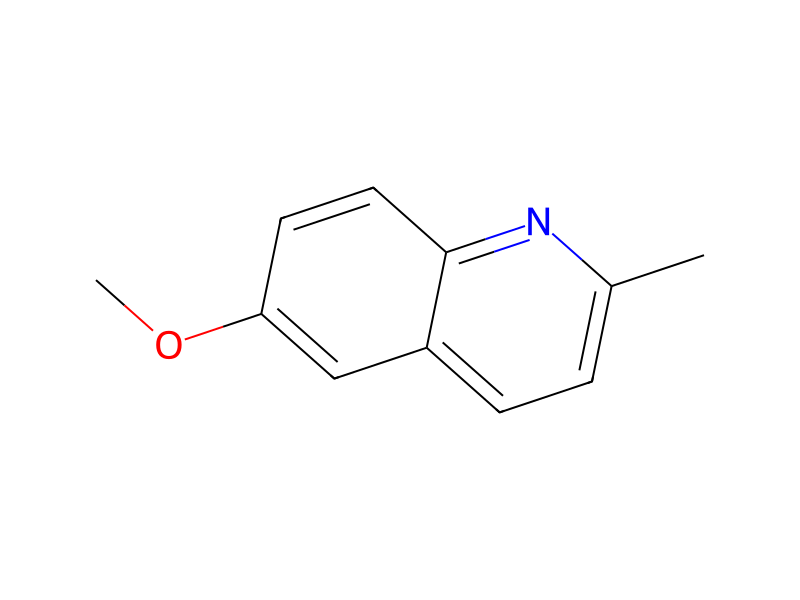
Product 1

Reagents, catalysts & solvents 1

Procedure
A solution of 6-methoxy-2-methylquinoline (177 g, 1.02 mol) in acetonitrile (1.77 L) was cooled to 0-3° C. followed by portion-wise addition of N-bromo-succinimide (200 g, 1.12 mol) over a period of 30 min while maintaining the same temperature. The resulted brown slurry was warmed to ambient temperature and stirred for an additional 6 h. The reaction was then quenched by a 10% NaHSO3 solution (211 mL). The reaction mixture was concentrated to a volume of 600 mL then slowly poured into 0.1 N NaOH (2.5 L). The slurry (pH=9) was stirred at room temperature for 1 h then filtered, washed with water (2×1 L) and dried in a vacuum oven to give 253 g (98.6%) of the title compound as a brown solid. Rf=0.39 (3:7) EtOAc:heptane; 1H NMR (DMSO) δ 8.30 (d, J=6.5 Hz, 1H), 7.98 (d, J=6.9 Hz, 1H), 7.70 (d, J=7.0 Hz, 1H), 7.47 (d, J=6.5 Hz, 1H), 4.02 (s, 3H), 2.66 (s, 3H);
Workup
- temperaturewhile maintaining the same temperature
- customThe reaction was then quenched by a 10% NaHSO3 solution (211 mL)
- concentrationThe reaction mixture was concentrated to a volume of 600 mL
- additionthen slowly poured into 0.1 N NaOH (2.5 L)
- stirringThe slurry (pH=9) was stirred at room temperature for 1 h
- filtrationthen filtered
- washwashed with water (2×1 L)
- customdried in a vacuum oven
Sources & evidence
- ORD record
- ord-7743b5fbe0f04d2ca39178c39144b0a4
- Source dataset
- uspto-grants-2005_09
- Patent number
- US06939877B2
Linked notes
Loading…