Reaction equation

[CH3:1][CH2:2][C@@:3]1([OH:59])[CH2:21][N:19]2[CH2:20][C@H:5]([CH2:6][C@:7]([C:55]([O:57][CH3:58])=[O:56])([C:22]3[CH:23]=[C:24]4[C@:32]56[C@@H:36]7[C@:37]([CH2:52][CH3:53])([C@@H:41]([O:48]C(C)=O)[C@:42]([OH:47])([C:43]([O:45][CH3:46])=[O:44])[C@@H:31]5[N:30]([CH3:54])[C:25]4=[CH:26][C:27]=3[O:28][CH3:29])[CH:38]=[CH:39][CH2:40][N:35]7[CH2:34][CH2:33]6)[C:8]3[NH:16][C:15]4[CH:14]=[CH:13][CH:12]=[CH:11][C:10]=4[C:9]=3[CH2:17][CH2:18]2)[CH2:4]1.CC[C@@]1(O)CN2C[C@H](C[C@](C(OC)=O)(C3C=C4[C@]56[C@@H]7[C@](CC)([C@@H](OC(C)=O)[C@](O)(C(OC)=O)[C@@H]5N(C)C4=CC=3OC)C=CCN7CC6)C3NC4C=CC=CC=4C=3CC2)C1.OS(O)(=O)=O>NN.C(O)C>[CH3:1][CH2:2][C@@:3]1([OH:59])[CH2:21][N:19]2[CH2:20][C@@H:5]([CH2:6][C@:7]([C:55]([O:57][CH3:58])=[O:56])([C:22]3[CH:23]=[C:24]4[C:32]56[C@@H:31]([N:30]([CH3:54])[C:25]4=[CH:26][C:27]=3[O:28][CH3:29])[C@@:42]([OH:47])([C:43]([O:45][CH3:46])=[O:44])[C@H:41]([OH:48])[C@:37]3([CH2:52][CH3:53])[CH:38]=[CH:39][CH2:40][N:35]([C@H:36]53)[CH2:34][CH2:33]6)[C:8]3[NH:16][C:15]4[C:10](=[CH:11][CH:12]=[CH:13][CH:14]=4)[C:9]=3[CH2:17][CH2:18]2)[CH2:4]1Participants
Reactant 2
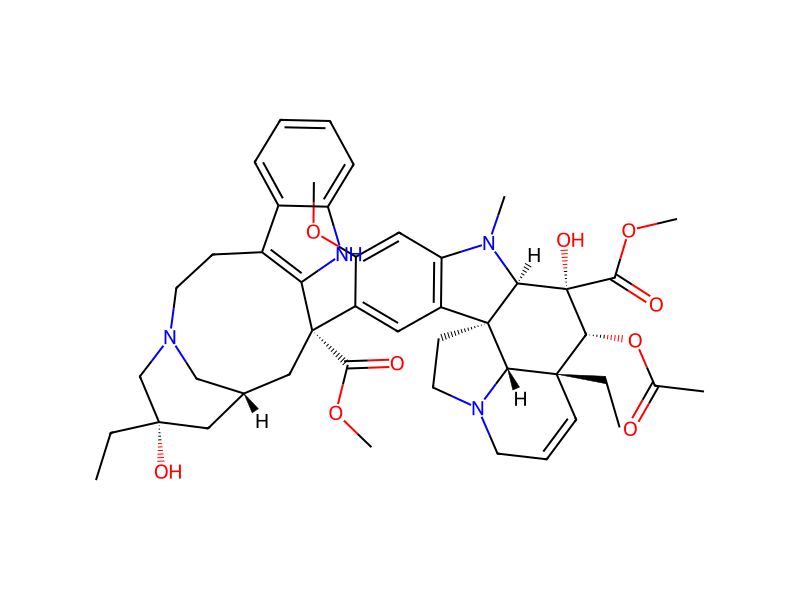

Product 1

Reagents, catalysts & solvents 1

Procedure
Vinca alkaloids such as vinblastine can be conjugated directly to aldehyde-bearing linkers following conversion to a hydrazide form as described by Brady et al. (J. Med. Chem., 45:4706-4715, 2002). Briefly, vinblastine sulfate is dissolved in 1:1 hydrazine/ethanol and heated to 60° C.-65° C. for 22 hours to yield desacetylvinblastine 3-carboxhydrazide (Table 2, DAVCH). Alternatively, amine-reactive forms of vinblastine may be generated in situ as described by Trouet et al. (U.S. Pat. No. 4,870,162) by (1) initially converting vinblastine sulfate to the desacetyl form (e.g. as described by Brady et al., reacting with 1:3 hydrazine/methanol at 20° C. for 20 hours), (2) reacting the resulting free base with approximately 2-fold excess succinic anhydride to generate the hemisuccinate (Table 2, DAVS), and (3) reacting with isobutyl chloroformate to form the reactive mixed anhydride.
Workup
- temperatureheated to 60° C.-65° C. for 22 hours
Sources & evidence
- ORD record
- ord-a46daf678c7e43fd939a5eee01069ad7
- Source dataset
- uspto-grants-2010_08
- Patent number
- US07767803B2
Linked notes
Loading…