HuagongsheHuagongshe Chemistry Print Report · For research reference only
HRID 500069Generated: October 23, 2026
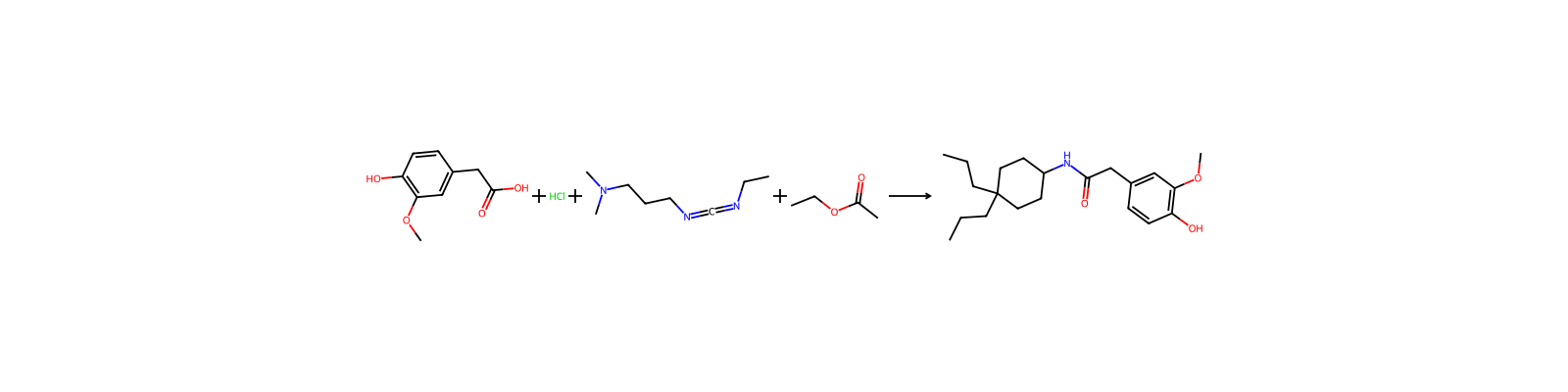
Homovanillic Acid → N-(4,4-dipropylcyclohexyl)-2-(4-hydroxy-3-methoxyphenyl)acetamide
https://huagongshe.com/en/reaction/500069
Participants
| Role | Name | HCID | Charge |
|---|
| Reactant | Homovanillic Acid | HCID 1738 | — |
| Reactant | Ethyl Acetate | HCID 8857 | — |
| Reactant | 1,3-Propanediamine, N'-(ethylcarbonimidoyl)-N,N-dimethyl-, monohydrochloride | HCID 2723939 | — |
| Product | N-(4,4-dipropylcyclohexyl)-2-(4-hydroxy-3-methoxyphenyl)acetamide | HCID 57626703 | — |
Reaction Steps
4,4-Dipropyl-2-cyclohexenone (2.0 g) was dissolved in ethanol (20 ml), 10% palladium/carbon (200 mg) was added to the solution, and the mixture was hydrogenated at 25° C. The catalyst was removed by filtration from the reaction mixture, and the solvent was removed in vacuo to give 4,4-dipropylcyclohexanone. The product was dissolved in methanol/water=1/1 (20 ml). Hydroxylamine hydrochloride (1.55 g) and sodium acetate (1.83 g) were added to the solution, and the mixture was stirred with heating at 50° C. for 12 hours. After removing the methanol in vacuo, the residue was extracted with ethyl acetate. The organic layer was washed with water, and the solvent was removed in vacuo. The residue was purified by a silica gel chromatography (eluent: gradient from 100% hexane/0% ethyl acetate to 0% hexane/100% ethyl acetate) to give 1.4 g of 4,4-dipropylcyclohexanone oxime. A solution of the product in tetrahydrofuran (10 ml) was added dropwise to a solution of lithium aluminium hydride (420 mg) in tetrahydrofuran (10 ml) under ice-cooling, and the mixture was stirred. After 3 hours, the reaction was quenched by adding water (0.42 ml), 15% aqueous sodium hydroxide (0.42 ml), and then water (1.26 ml) dropwise to the reaction mixture. The precipitate was filtered off and then the solvent was removed in vacuo. The residue was dissolved in 2 mol/l aqueous hydrochloric acid, washed with diethyl ether, basified with 2 mol/l aqueous sodium hydroxide, and then extracted with chloroform. The organic layer was concentrated under reduced pressure to give 165 mg of 4,4-dipropylcyclohexylamine. The product (100 mg) was dissolved in ethyl acetate (5 ml), and 4-hydroxy-3-methoxyphenyacetic acid (100 mg) and 1-ethyl-3-(3-dimethylaminopropyl)carbodiimide hydrochloride (110 mg) were added to the solution, and the mixture was stirred at 25° C. for 12 hours. The reaction mixture was washed with water and then the solvent was removed in vacuo. The residue was purified by a silica gel chromatography (eluent: gradient from 100% hexane/0% ethyl acetate to 0% hexane/100% ethyl acetate) to give 120 mg of the desired compound.
Provenance & Evidence
| DOI | 10.6084/m9.figshare.5104873.v1 |
|---|
| Patent number | US07767854B2 |
|---|
| Source dataset | uspto-grants-2010_08 |
|---|
| ORD ID | ord-671197d5636649a894864d584c191b4c |
|---|
| Source note | uspto-grants-2010_08 |
|---|