2-Aminobenzyl alcohol → (2-Aminobenzyl)triphenylphosphonium bromide
Reaction equation

[NH2:1][C:2]1[CH:9]=[CH:8][CH:7]=[CH:6][C:3]=1[CH2:4]O.[BrH:10].[C:11]1([P:17]([C:24]2[CH:29]=[CH:28][CH:27]=[CH:26][CH:25]=2)[C:18]2[CH:23]=[CH:22][CH:21]=[CH:20][CH:19]=2)[CH:16]=[CH:15][CH:14]=[CH:13][CH:12]=1>C(#N)C>[Br-:10].[C:24]1([P+:17]([C:11]2[CH:12]=[CH:13][CH:14]=[CH:15][CH:16]=2)([C:18]2[CH:23]=[CH:22][CH:21]=[CH:20][CH:19]=2)[CH2:4][C:3]2[CH:6]=[CH:7][CH:8]=[CH:9][C:2]=2[NH2:1])[CH:25]=[CH:26][CH:27]=[CH:28][CH:29]=1Participants
4
Reactant 2

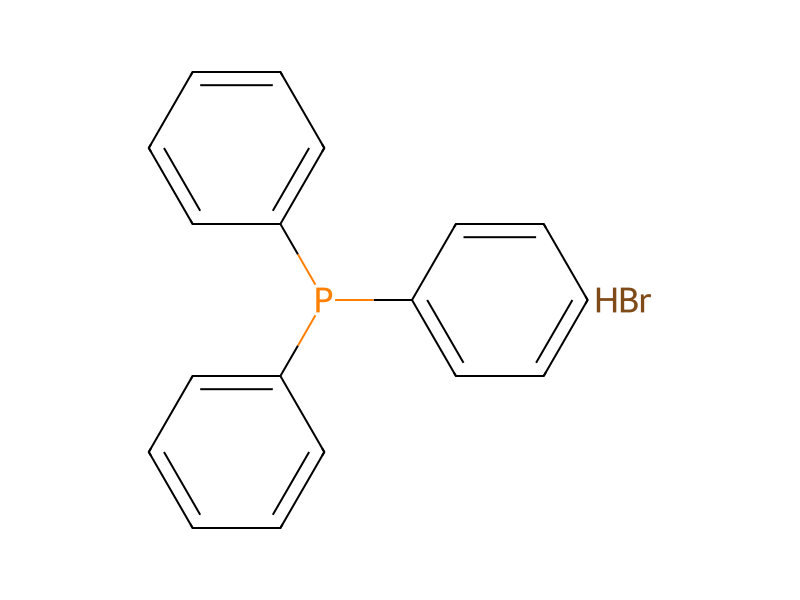
Product 1

Reagents, catalysts & solvents 1

Procedure
2-Aminobenzyl alcohol (60.0 g, 0.487 mol) was dissolved in acetonitrile (2.5 L) and brought to reflux. Triphenylphosphine hydrobromide (167 g, 0.487 mol) was added and the mixture was heated at reflux for 3 h. The reaction mixture was concentrated to approximately 500 mL and left at room temperature for 1 h. The precipitate was filtered and washed with cold acetonitrile followed by hexane. The solid was dried overnight at 40° C. under vacuum to give triphenyl(2-aminobenzyl)phosphonium bromide (193 g, 88%).
Workup
- temperatureto reflux
- temperaturethe mixture was heated
- temperatureat reflux for 3 h
- concentrationThe reaction mixture was concentrated to approximately 500 mL
- filtrationThe precipitate was filtered
- washwashed with cold acetonitrile
- customThe solid was dried overnight at 40° C. under vacuum
Sources & evidence
- ORD record
- ord-227b4532e15549158b6b7ee3e1fc86ec
- Source dataset
- uspto-grants-2010_08
- Patent number
- US07776905B2
Reaction notes
Loading…