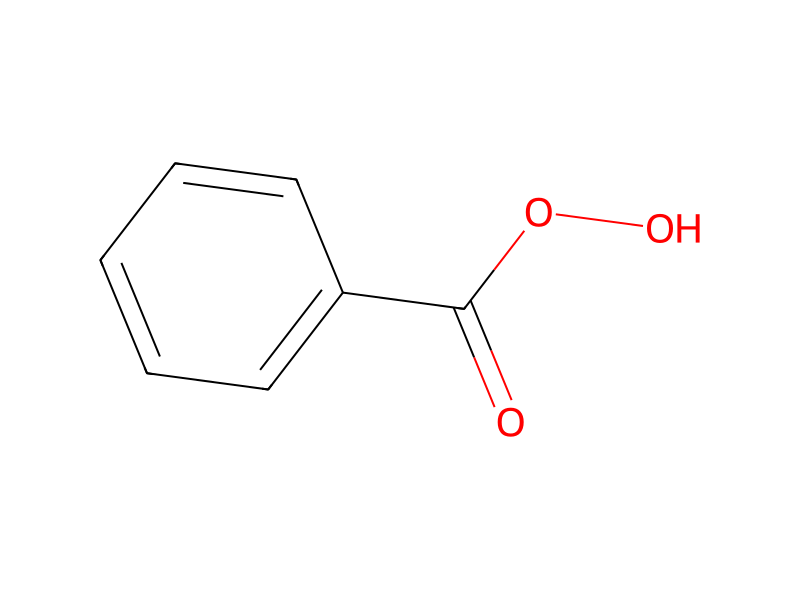
[C:1]([O:5][C:6]([O:8][C:9]1[CH:17]=[CH:16][CH:15]=[CH:14][C:10]=1[C:11]([OH:13])=[O:12])=[O:7])([CH3:4])([CH3:3])[CH3:2].[C:18]1([C:24]([O:26]O)=[O:25])[CH:23]=[CH:22][CH:21]=[CH:20][CH:19]=1.C1(N=C=NC2CCCCC2)CCCCC1>C(OCC)C.ClCCl.C(OCC)C>[C:1]([O:5][C:6]([O:8][C:9]1[CH:17]=[CH:16][CH:15]=[CH:14][C:10]=1[C:11]([O:13][O:26][C:24](=[O:25])[C:18]1[CH:23]=[CH:22][CH:21]=[CH:20][CH:19]=1)=[O:12])=[O:7])([CH3:4])([CH3:2])[CH3:3]3 g (13 mmol) of 2-(tert-butoxycarbonyloxy)benzoic acid and 1.8 g (13 mmol) of benzenecarboperoxoic acid (prepared as described in Example 1-3) are dissolved in a diethyl ether/dichloromethane 6/4 mixture. The solution is cooled to 0° C. and then 2.6 g (13 mmol) of N,N′-dicyclohexylcarbodiimide dissolved in 50 ml of diethyl ether are added dropwise. After stirring at 0° C. for 3 hours, the reaction medium is filtered and then concentrated to dryness. The residue is purified by chromatography on silica gel eluted with a pentane/dichloromethane 4/6 mixture. 2.2 g of (2-(tert-butoxycarbonyloxy)benzoyl)benzoyl peroxide are obtained in the form of a white solid with a yield of 49%.
Loading…