1,5-Dichloroanthraquinone → 1,5-Bis((2-(dimethylamino)ethyl)(methyl)amino)anthracene-9,10-dione
HRID 522936
Reaction equation

Cl[C:2]1[C:15]2[C:14](=[O:16])[C:13]3[C:8](=[C:9](Cl)[CH:10]=[CH:11][CH:12]=3)[C:7](=[O:18])[C:6]=2[CH:5]=[CH:4][CH:3]=1.[CH3:19][N:20]([CH3:25])[CH2:21][CH2:22][NH:23][CH3:24]>O>[CH3:19][N:20]([CH3:25])[CH2:21][CH2:22][N:23]([CH3:24])[C:2]1[C:15]2[C:14](=[O:16])[C:13]3[C:8](=[C:9]([N:23]([CH2:22][CH2:21][N:20]([CH3:25])[CH3:19])[CH3:24])[CH:10]=[CH:11][CH:12]=3)[C:7](=[O:18])[C:6]=2[CH:5]=[CH:4][CH:3]=1Participants
4
Reactant 2

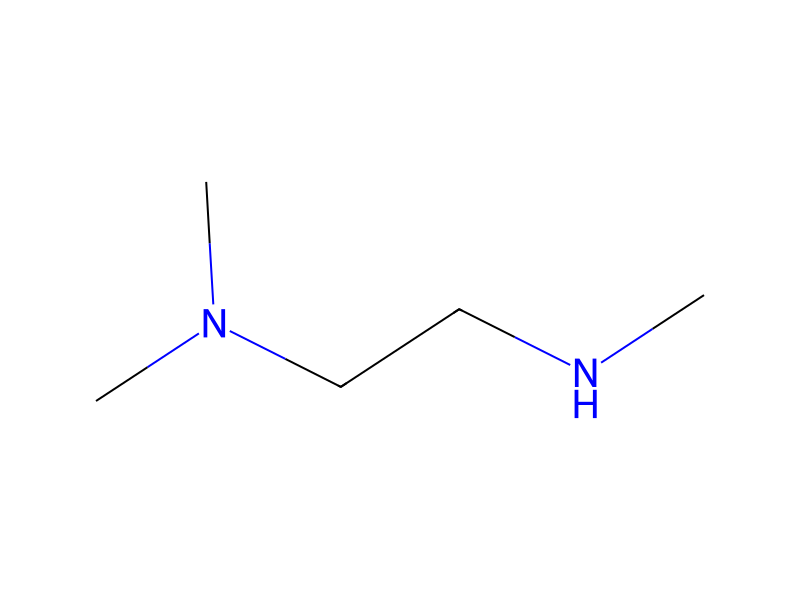
Product 1

Reagents, catalysts & solvents 1

Procedure
A mixture of 1,5-dichloroanthraquinone (5.5 g, 20 mmol) and N,N,N′-trimethylethylenediamine (40 ml) was refluxed for 18 h. The mixture was cooled to room temperature, diluted with water (400 mL) and extracted with chloroform (2×200 mL). The combined organic layer was washed with water, brine, dried over MgSO4 and evaporated to dryness. The residue thus obtained was purified by silica gel flash chromatography [CHCl3/MeOH/Et3N (44:5:1)] to provide Compound 9. Abs (max, PBS pH 7.4)=508 nm. The structure of Compound 9 is given below: