HomeMCPSkillsWorkbenchOpenChem
HomeWorkbenchNotificationsMe
llms.txt · skill.md · MCP GuidePrivacy Policy · Terms of Service · Supportv1.8.6
  1. Home
  2. /Reaction

Ethyl 2-isopropylthiazole-4-carboxylate → 2-(Propan-2-yl)-1,3-thiazole-4-carbaldehyde

HRID 52724
Print

Reaction equation

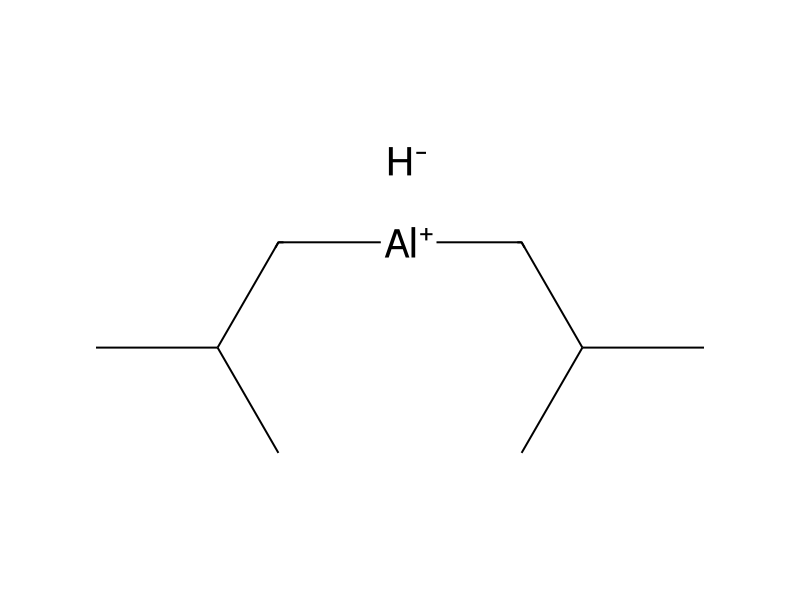
[CH:1]([C:4]1[S:5][CH:6]=[C:7]([C:9](OCC)=[O:10])[N:8]=1)([CH3:3])[CH3:2].[H-].C([Al+]CC(C)C)C(C)C>ClCCl.C1(C)C=CC=CC=1>[CH:1]([C:4]1[S:5][CH:6]=[C:7]([CH:9]=[O:10])[N:8]=1)([CH3:3])[CH3:2]
ParticipantsProcedureWorkupSources & evidenceReaction notes

Participants

5

Reactant 2

HCID 10535999Ethyl 2-isopropylthiazole-4-carboxylateHCID 21225700Diisobutylaluminumhydride

Product 1

HCID 27631922-(Propan-2-yl)-1,3-thiazole-4-carbaldehydeYield 56.6%

Reagents, catalysts & solvents 2

HCID 1140TolueneSolventHCID 6344DichloromethaneSolvent

Procedure

A solution of 3.1 g (15.6 mmol) of ethyl 2-isopropylthiazole-4-carboxylate in 50 ml of dichloromethane was cooled under N2 atmosphere to -78° C. and treated dropwise with 15.6 ml (23.4 mmol) of a 1.5M solution of diisobutylaluminum hydride in toluene over a period of 1.5 h. After being stirred for an additional 0.5 h, the solution was quenched with 5 ml of methanol followed by 15 ml of aqueous Rochelle's salt. The resulting mixture was partitioned between chloroform and aqueous Rochelle's salt, dried over Na2SO4, and concentrated to provide 1.37 g (56%) of the crude desired compound, Rf 0.47 (20% ethyl acetate in hexane). 1H NMR (CDCl3) δ1.45 (d, J=7 Hz, 6H), 3.39 (heptet, J=7 Hz, 1H), 8.07 (s, 1H), 10.00 (s, 1H). Mass spectrum: (M+H)+ =156.

Workup

  1. customthe solution was quenched with 5 ml of methanol
  2. customThe resulting mixture was partitioned between chloroform and aqueous Rochelle's salt
  3. dry with materialdried over Na2SO4
  4. concentrationconcentrated

Sources & evidence

ORD record
ord-6bba1b3c48954e1296d194c720ffa887
Source dataset
uspto-grants-1997_04
DOI
10.6084/m9.figshare.5104873.v1
Patent number
US05616720

Reaction notes

On this pageParticipantsProcedureWorkupSources & evidenceReaction notes