HuagongsheHuagongshe Chemistry Print Report · For research reference only
HRID 53Generated: October 23, 2026
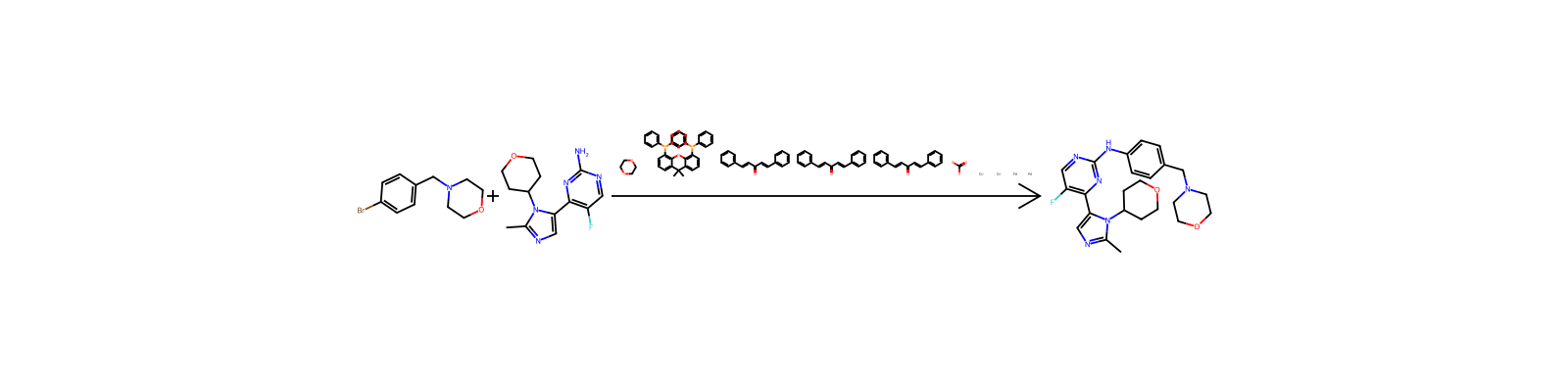
4-(4-Bromobenzyl)morpholine → 5-fluoro-4-[2-methyl-3-(oxan-4-yl)imidazol-4-yl]-N-[4-(morpholin-4-ylmethyl)phenyl]pyrimidin-2-amine
https://huagongshe.com/en/reaction/53
Participants
| Role | Name | HCID | Charge |
|---|
| Reactant | 4-(4-Bromobenzyl)morpholine | HCID 783503 | — |
| Reactant | 5-fluoro-4-(2-methyl-1-(tetrahydro-2H-pyran-4-yl)-1H-imidazol-5-yl)pyrimidin-2-amine | HCID 16665498 | — |
| Reagent | Cesium carbonate | HCID 10796 | — |
| Catalyst | 1,1'-(9,9-Dimethyl-9H-xanthene-4,5-diyl)bis(1,1-diphenylphosphine) | HCID 636044 | — |
| Catalyst | Bis(dibenzylideneacetone)palladium | HCID 9811564 | — |
| Solvent | 1,4-Dioxane | HCID 31275 | — |
| Product | 5-fluoro-4-[2-methyl-3-(oxan-4-yl)imidazol-4-yl]-N-[4-(morpholin-4-ylmethyl)phenyl]pyrimidin-2-amine | HCID 16665251 | 85.5% |
Reaction Steps
The aim of the reaction is optimization. Tris(dibenzylideneacetone)dipalladium(0) (4.5 mg, 4.91 µmol) and 9,9-Dimethyl-4,5-bis(diphenylphosphino)xanthene (5.1 mg, 8.81 µmol) were dissolved in dioxane (1.8 mL) in a 10 mL Schlenk tube and activated at 100 °C for 6 min under argon. Then 5-fluoro-4-(2-methyl-1-(tetrahydro-2H-pyran-4-yl)-1H-imidazol-5-yl)pyrimidin-2-amine (51 mg, 0.18 mmol), 4-(4-bromobenzyl)morpholine (51 mg, 0.20 mmol) and Cesium carbonate (94 mg, 0.29 mmol) were added. It was degassed again and stirred at 100 °C under argon. The reaction was followed by HPLC. After 26 h 85.5 % conversion was obtained. 20 % by-product formation was detected. Finally, the reaction mixture was discarded.
Provenance & Evidence
| Source dataset | 750 AstraZeneca ELN dataset |
|---|
| ORD ID | ord-f88e9fa13a294cdea3238d7489919aa6 |
|---|
| Source note | 750 AstraZeneca ELN dataset |
|---|