Bromine → HCID 19079294, compound
Reaction equation
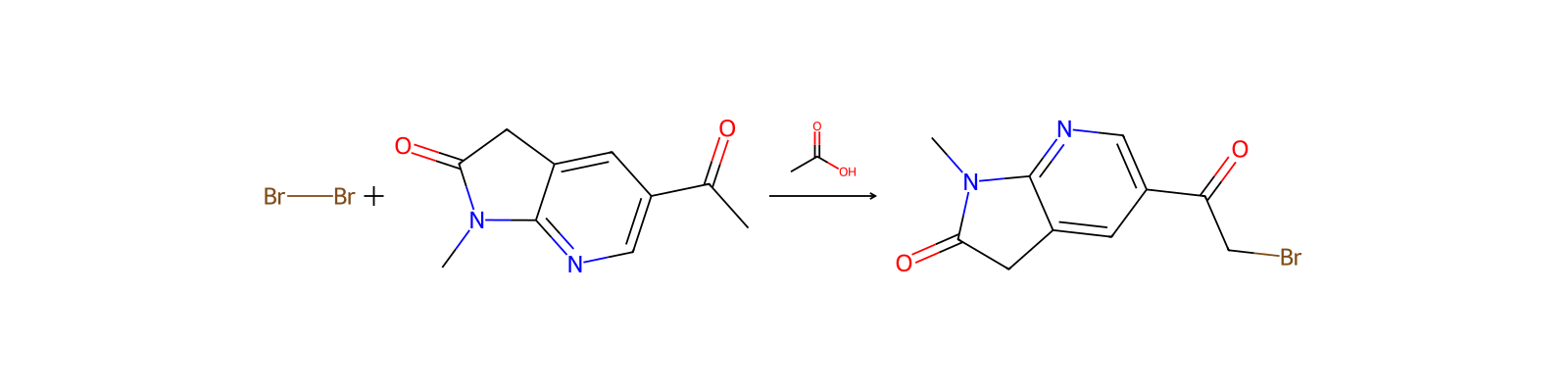
[Br:1]Br.[CH3:3][N:4]1[C:8]2=[N:9][CH:10]=[C:11]([C:13](=[O:15])[CH3:14])[CH:12]=[C:7]2[CH2:6][C:5]1=[O:16]>C(O)(=O)C>[Br:1][CH2:14][C:13]([C:11]1[CH:12]=[C:7]2[CH2:6][C:5](=[O:16])[N:4]([CH3:3])[C:8]2=[N:9][CH:10]=1)=[O:15]Participants
4
Reactant 2


Product 1

Reagents, catalysts & solvents 1

Conditions
- Temperature
- 80 °C
Procedure
Add 170 mg (1.05 mmol) of bromine dissolved in 1 ml of acetic acid dropwise to a solution of 200 mg (1.05 mmol) of 1,3-dihydro-1-methyl-5-acetyl-2H-pyrrolo[2,3-b]pyridin-2-one (obtained as described in Example 13 hereinafter) in 4 ml of acetic acid. After 6 hours' heating at 80° C., the acetic acid is removed under reduced pressure and the residue is taken up in water and then extracted with dichloromethane. The crude product obtained is purified by chromatography on silica gel (eluant ethyl acetate/petroleum ether/dichloromethane, 1/1/1). Yield: 60%. ##STR43##