Reaction equation

C([Li])CCC.[CH:6]1([NH:9][C:10]([C:12]2[N:13]=[C:14]([CH:17]([CH3:19])[CH3:18])[O:15][CH:16]=2)=[O:11])[CH2:8][CH2:7]1.[C:20](=[O:22])=[O:21]>CCCCCC.O1CCCC1>[CH:6]1([NH:9][C:10]([C:12]2[N:13]=[C:14]([CH:17]([CH3:19])[CH3:18])[O:15][C:16]=2[C:20]([OH:22])=[O:21])=[O:11])[CH2:7][CH2:8]1Participants
Reactant 3

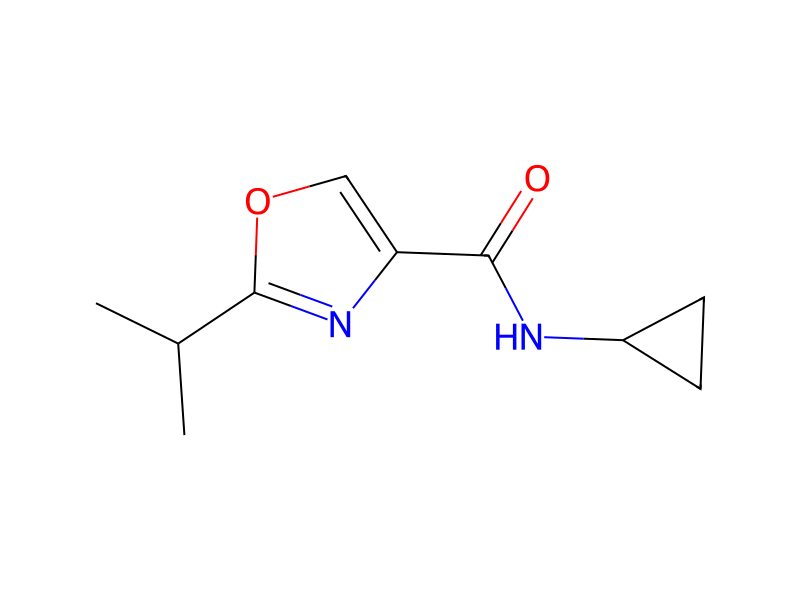

Product 1

Reagents, catalysts & solvents 2


Procedure
At -70° C. and under a nitrogen blanket, 0.12 mol of n-butyllithium (80.0 ml of a 1.5 molar solution in hexane) was dripped into a solution of 10.4 g (0.054 mol) of 2-isopropyloxazole-4-carboxylic acid-cyclopropylamide in 250 ml of tetrahydrofuran, and the mixture was stirred for 30 minutes at this temperature. The reaction mixture was then poured onto 500 g of solid CO2 and allowed to stand overnight. The residue remaining after evaporating down was taken up in 200 ml of water and 30 ml of 2N NaOH, the solution was extracted twice, each time with 100 ml of diethyl ether, the aqueous phase was acidified to a pH of 2 with concentrated hydrochloric acid and the solution extracted three times, each time with 200 ml of ethyl acetate. Drying over magnesium sulfate and removal of the solvent under reduced pressure gave 10.4 g (81%) of 4-cyclopropylaminocarbonyl-2-isopropyloxazole-5-carboxylic acid as a white powder of m.p. 109°-112° C. (active ingredient no. 3.007).
Workup
- customAt -70° C.
- waitto stand overnight
- customafter evaporating down
- extraction30 ml of 2N NaOH, the solution was extracted twice
- extractionthe solution extracted three times
- dry with materialDrying over magnesium sulfate and removal of the solvent under reduced pressure
Sources & evidence
- ORD record
- ord-6db241b1de6942798489126e4163fdde
- Source dataset
- uspto-grants-1993_09
- Patent number
- US05244867
Linked notes
Loading…