Reaction equation
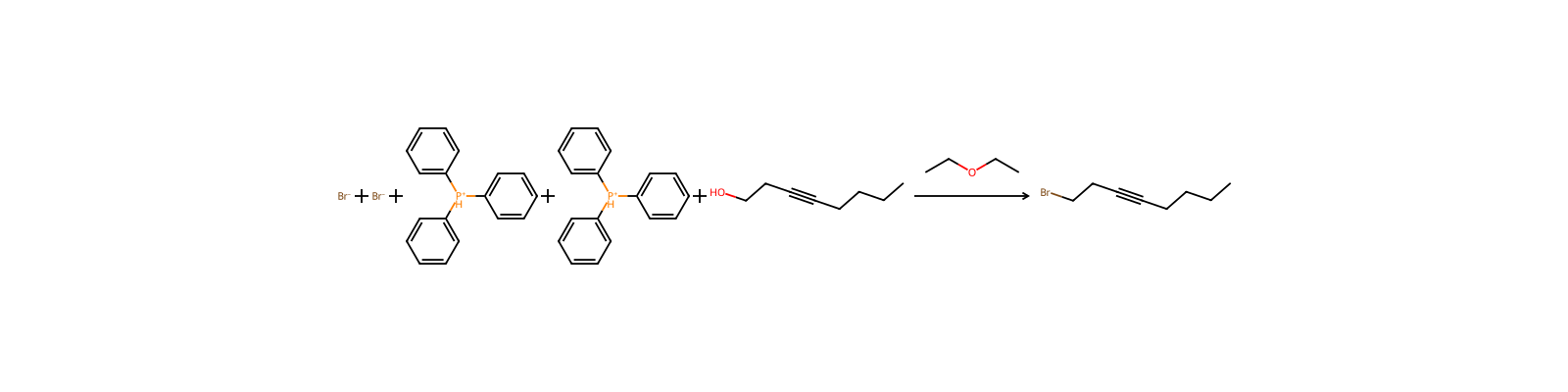
[Br-:1].[Br-].C1([PH+](C2C=CC=CC=2)C2C=CC=CC=2)C=CC=CC=1.C1([PH+](C2C=CC=CC=2)C2C=CC=CC=2)C=CC=CC=1.[CH2:41](O)[CH2:42][C:43]#[C:44][CH2:45][CH2:46][CH2:47][CH3:48]>C(OCC)C>[Br:1][CH2:41][CH2:42][C:43]#[C:44][CH2:45][CH2:46][CH2:47][CH3:48]Participants
Reactant 2

Product 1

Reagents, catalysts & solvents 1

Procedure
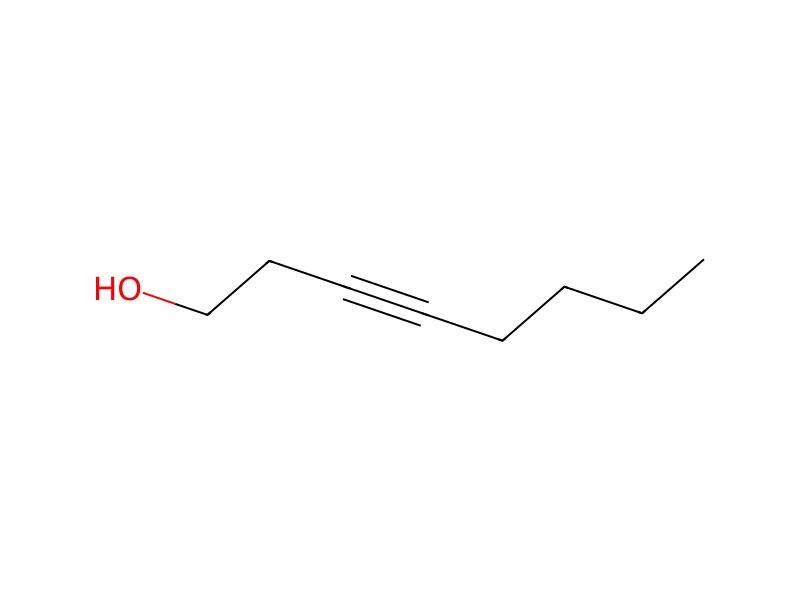
Triphenylphosphonium dibromide (36.8 g, 87.2 mmol) was suspended in diethyl ether at -20° C. and a solution of 3-octyne-1-ol (10.0 g, 79.2 mmol) was added dropwise over a twenty minute period. The mixture was allowed to stir overnight. The mixture was poured into ice-water and solids precipitated which were collected by filtration. The organic layer was separated, washed with 1N aqueous sodium hydroxide, water and dried over magnesium sulfate. The organic layer was then filtered and concentrated in vacuo to give a residue which was taken up in hexanes, filtered to remove undissolved material and concentrated to give 1-bromo-3-octyne as an orange oil (14.2 g, 96%). 1H NMR (300 MHZ) spectral data were consistent with the desired bromide (plus a trace of triphenylphosphine), and the crude product was used directly in the next step.
Workup
- customprecipitated which
- filtrationwere collected by filtration
- customThe organic layer was separated
- washwashed with 1N aqueous sodium hydroxide, water
- dry with materialdried over magnesium sulfate
- filtrationThe organic layer was then filtered
- concentrationconcentrated in vacuo
- customto give a residue which
- filtrationfiltered
- customto remove undissolved material
- concentrationconcentrated
Sources & evidence
- ORD record
- ord-96aa29c54d404a43be507e98ba46a7b6
- Source dataset
- uspto-grants-1997_04
- Patent number
- US05620677
Linked notes
Loading…