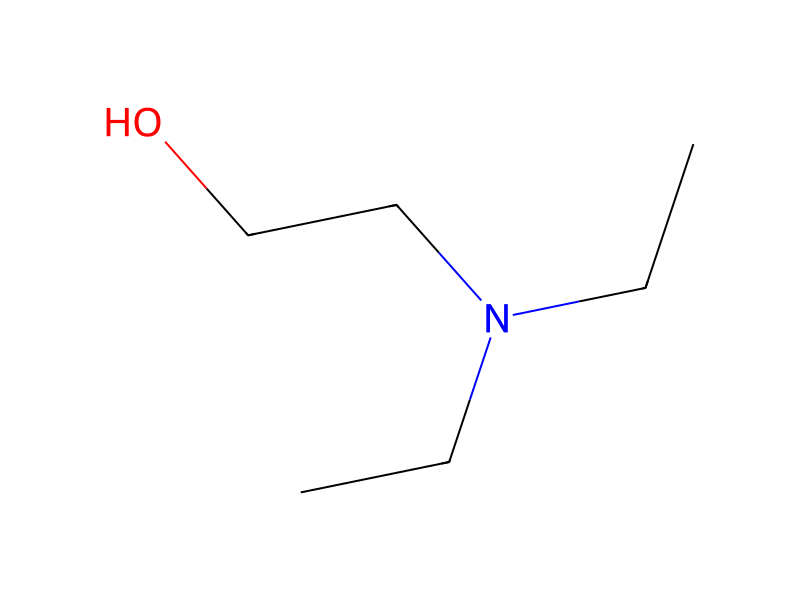
Diethylethanolamine → HCID 54248583, compound
HRID 544702
Reaction equation

[N:1]([C:4]1[CH:14]=[CH:13][C:7]([CH:8]=[CH:9][C:10](Cl)=[O:11])=[CH:6][CH:5]=1)=[N+:2]=[N-:3].[CH2:15]([N:17]([CH2:21][CH3:22])[CH2:18][CH2:19][OH:20])[CH3:16]>C(Cl)(Cl)Cl>[N:1]([C:4]1[CH:14]=[CH:13][C:7]([CH:8]=[CH:9][C:10]([O:20][CH2:19][CH2:18][N:17]([CH2:21][CH3:22])[CH2:15][CH3:16])=[O:11])=[CH:6][CH:5]=1)=[N+:2]=[N-:3]Participants
4
Reactant 2

Product 1

Reagents, catalysts & solvents 1

Procedure
In 80 g of chloroform was dissolved 6.2 g (30 millimoles) of the p-azidocinnamic acid chloride obtained in Example 16, and 3.5 g (30 millimoles) of 2-diethylaminoethanol was added dropwise while maintaining the solution temperature at 10° to 20° C., after which the resulting mixture was allowed to react for 1 hour. The chloroform was distilled off under reduced pressure, and 100 ml of water was added to the resulting oily substance, after which a solution of 1.3 g of sodium hydroxyde in 20 ml of water was added thereto on an ice bath. The organic layer separated was extracted with chloroform, and the extract was further washed with water and then dried over anhydrous sodium sulfate. The solvent was distilled off to obtain 7.2 g of an oily substance as the distillation residue. This oily substance decomposed at 130° C. with formation of bubbles and generation of heat. This oily substance was identified as the compound of this invention by analysis using the following spectral means. ##STR117##