HomeMCPWorkbenchSkills
HomeWorkbenchNotificationsMe
llms.txt · MCP GuidePrivacy Policy · Terms of Service · Supportv1.8.3
  1. Home
  2. /Reaction

2,7-Dibromo-9-fluorenone → 2-Bromo-7-(5-methylhexahydropyrrolo[3,4-c]pyrrol-2-yl)-fluoren-9-one

HRID 553058
Print

Reaction equation

HRID 553058 reaction equation
[CH3:1][N:2]1[CH2:9][CH:8]2[CH:4]([CH2:5][NH:6][CH2:7]2)[CH2:3]1.Br[C:11]1[CH:23]=[CH:22][C:21]2[C:20]3[C:15](=[CH:16][C:17]([Br:24])=[CH:18][CH:19]=3)[C:14](=[O:25])[C:13]=2[CH:12]=1.C1(P(C2C=CC=CC=2)C2C=CC3C(=CC=CC=3)C=2C2C3C(=CC=CC=3)C=CC=2P(C2C=CC=CC=2)C2C=CC=CC=2)C=CC=CC=1.CC(C)([O-])C.[Na+]>C1(C)C=CC=CC=1.C1C=CC(/C=C/C(/C=C/C2C=CC=CC=2)=O)=CC=1.C1C=CC(/C=C/C(/C=C/C2C=CC=CC=2)=O)=CC=1.C1C=CC(/C=C/C(/C=C/C2C=CC=CC=2)=O)=CC=1.[Pd].[Pd]>[Br:24][C:17]1[CH:18]=[CH:19][C:20]2[C:21]3[C:13](=[CH:12][C:11]([N:6]4[CH2:7][CH:8]5[CH:4]([CH2:3][N:2]([CH3:1])[CH2:9]5)[CH2:5]4)=[CH:23][CH:22]=3)[C:14](=[O:25])[C:15]=2[CH:16]=1
ParticipantsConditionsProcedureWorkupSources & evidenceReaction notes

Participants

7

Reactant 4

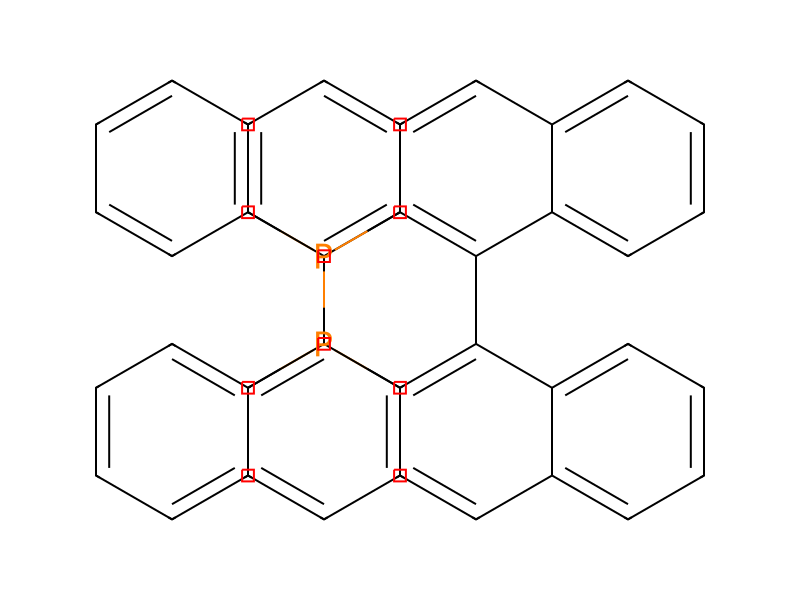
HCID 2599222,7-Dibromo-9-fluorenoneHCID 634876Binap, (A+-)-HCID 129585332-Methyloctahydropyrrolo(3,4-c)pyrroleHCID 23676156Sodium t-butoxide

Product 1

HCID 671645522-Bromo-7-(5-methylhexahydropyrrolo[3,4-c]pyrrol-2-yl)-fluoren-9-oneYield 44%

Reagents, catalysts & solvents 2

HCID 9811564Bis(dibenzylideneacetone)palladiumCatalystHCID 1140TolueneSolvent

Conditions

Temperature
90 °C

Procedure

A mixture of 3-methyl-3,7-diazabicyclo[3.3.0]octane (297 mg, 2.36 mmol; see Example 54C), 2,7-dibromofluoren-9-one (680 g, 2.01 mmol; Aldrich), tris(dibenzylideneacetone)dipalladium (0) (Pd2 dba3; 37 mg, 0.040 mmol; Alfa), racemic-2,2′-bis(diphenylphosphino)-1,1′-binaphthyl (BINAP; 63 mg, 0.10 mmol; Strem) and sodium tert-butoxide (270 mg, 2.81 mmol; Acros) in 10 mL toluene was warmed to 90° C. and stirred for 16 h. The reaction mixture was cooled to ambient temperature and filtered through Celite, rinsing with CH2Cl2. After concentrating the solution under reduced pressure, the residue was purified by flash chromatography (120 g silica gel, 1-20% gradient of NH4OH-MeOH (1:10) in CH2Cl2) to give the crude product. This material was purified further by flash chromatography (40 g Analogix NH2 column, 10-100% EtOAc in hexanes) to afford the title compound as a reddish solid (335 mg, 0.875 mmol; 44% yield): 1H NMR (300 MHz, CDCl3) δ ppm 7.64 (d, J=2 Hz, 1H), 7.49 (dd, J=8, 2 Hz, 1H), 7.29 (d, J=8 Hz, 1H), 7.19 (d, J=8 Hz, 1H), 6.95 (d, J=2 Hz, 1H), 6.64 (dd, J=8, 2 Hz, 1H), 3.42-3.53 (m, 2H), 3.29 (dd, J=10, 3 Hz, 2H), 2.99-3.13 (m, 2H), 2.75-2.94 (m, 2H), 2.56 (dd, J=9, 3 Hz, 2H), 2.41 (s, 3H); MS (ESI): m/z 383 (M+1)+, 385 (M+3)+.

Workup

  1. temperatureThe reaction mixture was cooled to ambient temperature
  2. filtrationfiltered through Celite
  3. washrinsing with CH2Cl2
  4. concentrationAfter concentrating the solution under reduced pressure
  5. customthe residue was purified by flash chromatography (120 g silica gel, 1-20% gradient of NH4OH-MeOH (1:10) in CH2Cl2)
  6. customto give the crude product
  7. customThis material was purified further by flash chromatography (40 g Analogix NH2 column, 10-100% EtOAc in hexanes)

Sources & evidence

ORD record
ord-90d841e048284148b67758003e593360
Source dataset
uspto-grants-2011_05
DOI
10.6084/m9.figshare.5104873.v1
Patent number
US07951791B2

Reaction notes

On this pageParticipantsConditionsProcedureWorkupSources & evidenceReaction notes