Reaction equation
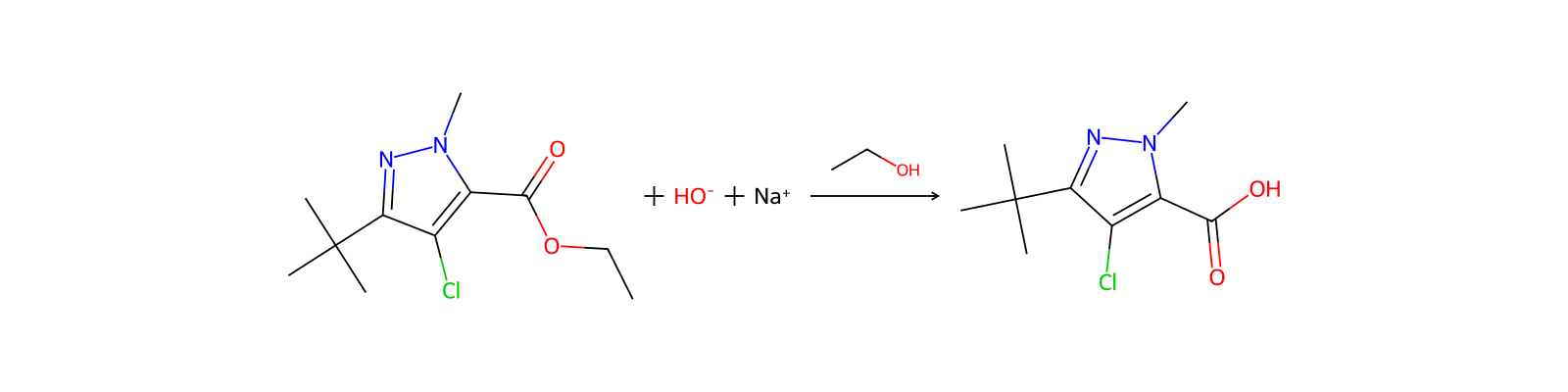
[C:1]([C:5]1[C:9]([Cl:10])=[C:8]([C:11]([O:13]CC)=[O:12])[N:7]([CH3:16])[N:6]=1)([CH3:4])([CH3:3])[CH3:2].[OH-].[Na+]>CCO>[C:1]([C:5]1[C:9]([Cl:10])=[C:8]([C:11]([OH:13])=[O:12])[N:7]([CH3:16])[N:6]=1)([CH3:4])([CH3:2])[CH3:3]Participants
Reactant 2


Product 1

Reagents, catalysts & solvents 1

Procedure
A 12-L, four neck round bottom flask equipped with overhead air stirrer, positive pressure nitrogen inlet, thermocouple, and addition funnel was charged with ethyl 3-tert-butyl-4-chloro-1-methyl-1H-pyrazole-5-carboxylate (282 g, 1.15 mol) and EtOH (4.3 L). 3M NaOH (960 mL, 2.87 mol) was added in one portion and the resulting slurry began to clarify immediately. The resulting mixture was stirred at room temperature for 2 h and yielded a turbid solution. The turbid solution was evaporated and the resulting aqueous slurry was diluted with H2O (2 L). The basic solution was acidified to pH˜2 using concentrated HCl. The aqueous layer was extracted with dichloromethane (2×800 mL), dried over MgSO4, filtered, and evaporated to yield 3-tert-butyl-4-chloro-1-methyl-1H-pyrazole-5-carboxylic acid as an off-white solid. 1H NMR (CHLOROFORM-d) δ: 4.11 (s, 3H), 1.41 (s, 9H)
Workup
- additionthermocouple, and addition funnel
- customyielded a turbid solution
- customThe turbid solution was evaporated
- additionthe resulting aqueous slurry was diluted with H2O (2 L)
- extractionThe aqueous layer was extracted with dichloromethane (2×800 mL)
- dry with materialdried over MgSO4
- filtrationfiltered
- customevaporated
Sources & evidence
- ORD record
- ord-b21275651e444a088b9c9f9ffef2a057
- Source dataset
- uspto-grants-2015_05
- Patent number
- US09023846B2
Linked notes
Loading…