HuagongsheHuagongshe Chemistry Print Report · For research reference only
HRID 577Generated: October 24, 2026
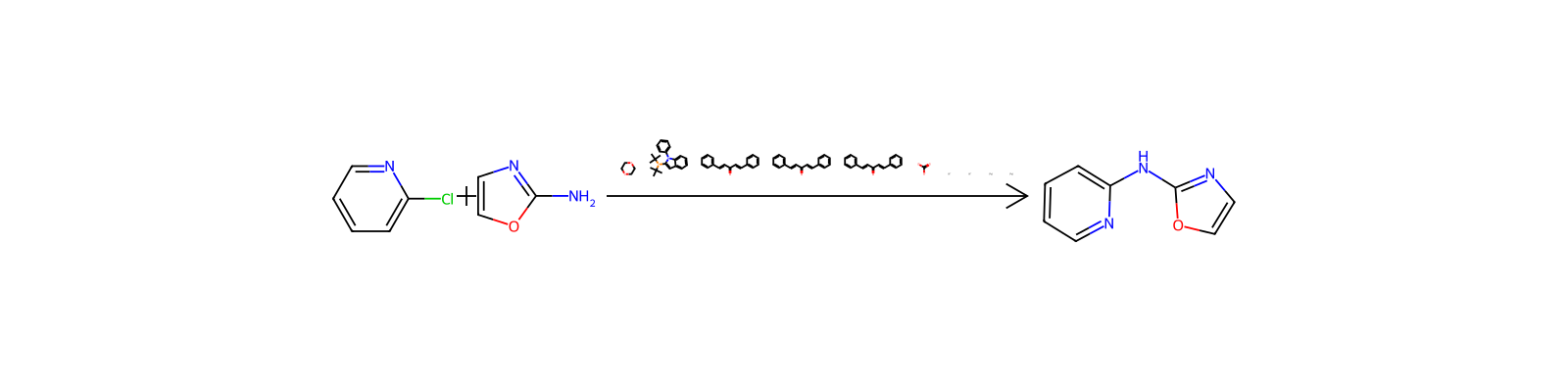
2-Chloropyridine → N-pyridin-2-yl-1,3-oxazol-2-amine
https://huagongshe.com/en/reaction/577
Participants
| Role | Name | HCID | Charge |
|---|
| Reactant | 2-Chloropyridine | HCID 7977 | — |
| Reactant | 2-Aminooxazole | HCID 558521 | — |
| Reagent | Potassium Carbonate | HCID 11430 | — |
| Catalyst | Bis(dibenzylideneacetone)palladium | HCID 9811564 | — |
| Catalyst | 2-(di-tert-butylphosphino)-N-phenylindole | HCID 11175133 | — |
| Solvent | 1,4-Dioxane | HCID 31275 | — |
| Product | N-pyridin-2-yl-1,3-oxazol-2-amine | HCID 67636727 | 0% |
Reaction Steps
Objective: Comparison of the reactivity of 2-aminooxazole in the coupling with 2-chloropyridine using three different catalyst systems ( previously shown to be the best performers in a 96-well Process Research and Development Screen) To an oven-dried microwave vial was added TRIS(DIBENZYLIDENEACETONE)DIPALLADIUM(0) (0.046 g, 0.05 mmol) and 2-(di-tert- butylphosphino)-1-phenyl-1H-indole (0.067 g, 0.2 mmol) and the vial was purged with nitrogen. dioxane (2 mL) (degassed) was added and the reaction mixture was heated to 50 °C for 40 min followed by heating to 90 °C for a further 15 min (Solution 1). To an oven dried microwave vial was added 2-chloropyridine (0.095 mL, 1 mmol), oxazol-2-amine (0.187 g, 2.00 mmol), potassium carbonate (0.207 g, 1.50 mmol) and 4,4'-di-tert-butylbiphenyl (0.027 g, 0.1 mmol). The vial was then capped and purged with nitrogen. To this was added the activated catalyst solution (Solution 1) . The reaction mixture was then heated to 90 °C for 16 h under an inert atmosphere. LCMS of the crude reaction mixture under basic conditions showed a peak which had the mass of the desired product, however, the chloropyridine starting material co-elutes under these conditions. Under acidic conditions none of the desired product mass was observed at Rt= 0.25 min (whereas for EN05378-80 and EN05378-81, the product mass was observed at this retention time). A product of mass corresponding to homo-coupled product was observed under basic conditions. Reaction not progressed. Conclusion: The 't-Butyl Beller ligand' was not efficent for the coupling of these substrates under the above conditions.
Provenance & Evidence
| Source dataset | 750 AstraZeneca ELN dataset |
|---|
| ORD ID | ord-05c9f5ab86694790884a2465aacb6f95 |
|---|
| Source note | 750 AstraZeneca ELN dataset |
|---|