Reaction equation

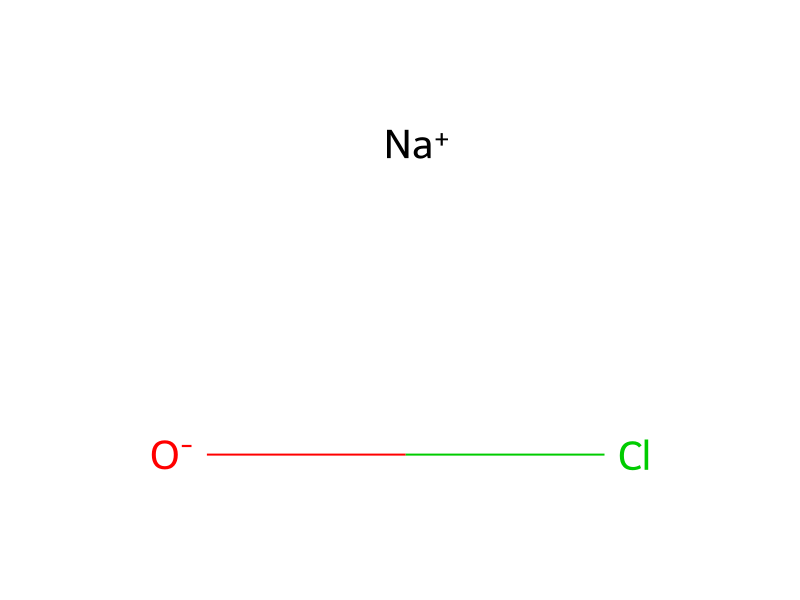
[OH2:1].Cl.[CH3:3][C:4]1[C:13]([C:14]([OH:16])=[O:15])=[CH:12][C:11]2[C:6](=[CH:7][CH:8]=[CH:9][CH:10]=2)[N:5]=1.[O-:17]Cl.[Na+]>ClCl.[OH-].[Na+].[Co]=O>[N:5]1[C:6]2[C:11](=[CH:10][CH:9]=[CH:8][CH:7]=2)[CH:12]=[C:13]([C:14]([OH:16])=[O:15])[C:4]=1[C:3]([OH:17])=[O:1]Participants
Reactant 3


Product 1

Reagents, catalysts & solvents 3



Conditions
- Temperature
- 65 °C
Procedure
To a reactor is added 30 ml of H2O and 15 g of 50% aqueous NaOH. The solution is heated to 65° C. and 3.85 g (0.051 mol) of cobalt oxide and 5 g (0.022 mol) of 2-methyl-3-quinolinecarboxylic acid hydrochloride are added with stirring. A chilled solution of 13 g (0.18 mol) of chlorine in 40 g of chlorine in 40 g of 25% aqueous NaOH (~24% aqueous NaOCl) is added over 3 hours. The solution is then stirred for 15 hours and an additional aliquot of 24% aqueous NaOCl (0.36 mol total) is added over 3 hours. After a total of 36 hours, the solution is filtered, chilled to 15° C. and acidified to pH 3. The solid material is removed by filtration. A product of 2.3 g of 2,3-quinolinedicarboxylic acid is obtained. This represents a yield of 77% based on consumed 2-methyl-3-quinolinecarboxylic acid. The reaction is illustrated as follows: ##STR13##
Workup
- stirringThe solution is then stirred for 15 hours
- filtrationAfter a total of 36 hours, the solution is filtered
- temperaturechilled to 15° C.
- customThe solid material is removed by filtration
Sources & evidence
- ORD record
- ord-534243105f324bd28d910221c133b33c
- Source dataset
- uspto-grants-1988_06
- Patent number
- US04750978
Linked notes
Loading…