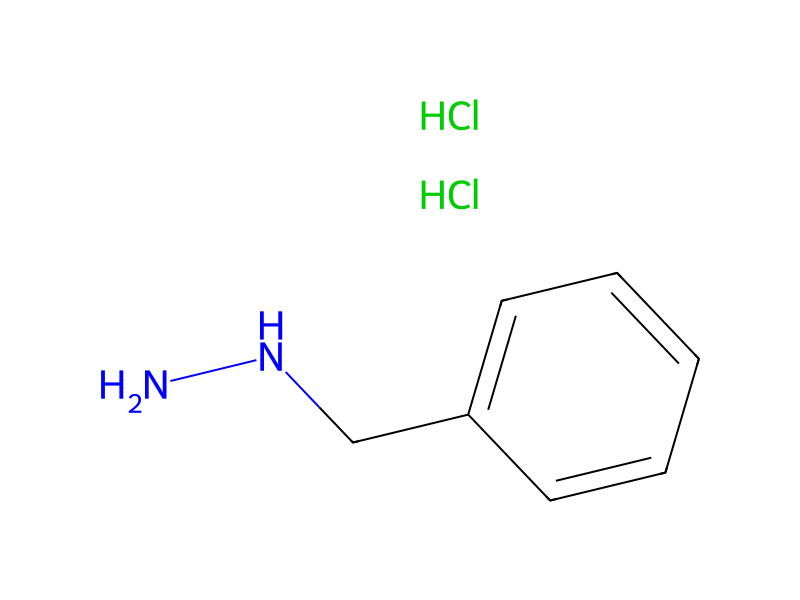
Benzylhydrazine dihydrochloride → 1-benzyl-5-(3,4-dihydro-2H-1-benzopyran-6-yl)-3-(trifluoromethyl)-1H-pyrazole
HRID 591076
Reaction equation

Cl.Cl.[CH2:3]([NH:10][NH2:11])[C:4]1[CH:9]=[CH:8][CH:7]=[CH:6][CH:5]=1.[O:12]1[C:17]2[CH:18]=[CH:19][C:20]([C:22](=O)[CH2:23][C:24](=O)[C:25]([F:28])([F:27])[F:26])=[CH:21][C:16]=2[CH2:15][CH2:14][CH2:13]1>C(#N)C>[CH2:3]([N:10]1[C:22]([C:20]2[CH:19]=[CH:18][C:17]3[O:12][CH2:13][CH2:14][CH2:15][C:16]=3[CH:21]=2)=[CH:23][C:24]([C:25]([F:28])([F:26])[F:27])=[N:11]1)[C:4]1[CH:9]=[CH:8][CH:7]=[CH:6][CH:5]=1Participants
4
Reactant 2

Product 1

Reagents, catalysts & solvents 1

Procedure
A solution of benzylhydrazine dihydrochloride (394 mg, 2.03 mmol) and 1-(3,4-dihydro-2H-1-benzopyran-6-yl)-4,4,4-trifluorobutane-1,3-dione (49b) (500 mg, 1.84 mmol) in acetonitrile (80 mL) was refluxed for 16 hours. The mixture was concentrated in vacuo and the residue was taken up in ethyl acetate (5 mL). The organic layer was successively washed with water (10 mL) and brine (10 mL) before being dried over sodium sulfate and concentrated in vacuo. The oil was purified by preparative TLC (cyclohexane/ethyl acetate 100/0 to 90/10) to provide the desired pyrazole (49c) (260 mg, 0.73 mmol, 39%).